search for ccna answer

Showing posts with label CCNA. Show all posts

Monday, March 10, 2014

CCNA 4 R&S Year 2014: Connecting Networks Chapter 1 v5.0 Exam Question with Answers

Connecting Networks Chapter 1 v5.0 Exam Answers 2014

1 
What are two structured engineering principles necessary for successful implementation of a network design? (Choose two.)
modularity*
security
availability
quality of service
resiliency*

2 
What is an important first consideration when starting to design a network?
size of the network* 
access security
protocols to be used
type of applications

3 
Which layer of the Cisco Collaboration Architecture contains unified communications and conference software such as Cisco WebEx Meetings, WebEx Social, Cisco Jabber, and TelePresence?
service provider edge
enterprise WAN
applications and devices* 
services module

4 
In which layer of the hierarchical enterprise LAN design model would PoE for VoIP phones and access points be considered?
core
physical
data link
access* 
distribution

5 
Which network module is the fundamental component of a campus design?
access-distribution module* 
services module
data center
enterprise edge

6 
In a hierarchical network design, which layers may be combined into a collapsed core for smaller networks?
core, distribution, and access
distribution and access
core and access
core and distribution*

7
Refer to the exhibit. Which type of ISP connectivity to the service provider edge is being used by company A?
dual-homed
dual-multihomed
single-homed
multihomed*

8 
What is one advantage to designing networks in building block fashion for large companies?
mobility
redundancy
increased network access time
failure isolation*

9 
A network engineer wants to redesign the wireless network and make use of wireless network controllers that manage the many deployed wireless access points. In which network design module of the campus network architecture would the centralized wireless network controllers be found?
services* 
access-distribution
enterprise edge
data center

10 
Which two devices would commonly be found at the access layer of the hierarchical enterprise LAN design model? (Choose two.)
Layer 3 device
firewall
access point* 
Layer 2 switch* 
modular switch

11 
Which approach in networking allows for network changes, upgrades, or the introduction of new services in a controlled and staged fashion?
modular* 
network module
borderless
static

12
Refer to the exhibit. Which type of Cisco hierarchical LAN design model is used at school site 1?
7 layer
two-tier collapsed core* 
three-tier
3 layer

13 
Which three network architectures have been introduced by Cisco to address the emerging technology challenges created by the evolving business models? (Choose three.)
Cisco Collaboration* 
Cisco Data Center* 
Cisco Borderless* 
Cisco Enterprise Edge
Cisco Enterprise Campus
Cisco Enterprise Branch

14 
Which Cisco technology allows diverse network devices to connect securely, reliably, and seamlessly to enterprise network resources?
Cisco AnyConnect*
enterprise edge
building distribution
service provider edge

15 
The network design for a college with users at five sites is being developed. Where in the campus network architecture would servers used by all users be located?
services
enterprise edge
data center* 
access-distribution

16 
What is creating a new challenge for IT departments by changing the border of the enterprise network?
tablets* 
company-owned desktops
energy costs
access layer switching

17 
Which network architecture functions through a combination of technologies that include wired, wireless, security, and more?
Cisco Borderless* 
Cisco Enterprise Campus
Cisco Enterprise Edge
Cisco Enterprise Branch

18 
Which network architecture combines individual components to provide a comprehensive solution allowing people to cooperate and contribute to the production of something?
Cisco Enterprise Campus Architecture
Cisco Enterprise Branch Architecture
Cisco Borderless Network Architecture
Cisco Collaboration Architecture*

19 
Fill in the blank.
Reducing the complexity of network design by dividing a network into smaller
areas is an example of a ” hierarchical ” network model.​

20 
Fill in the blank. Use the abbreviation.
Under the Cisco Enterprise Edge module, the submodule that provides remote access
including authentication and IPS appliances is the ” VPN ” and remote access submodule.

21
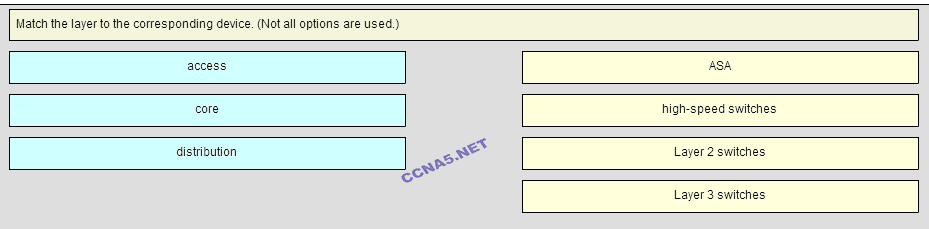
Place the options in the following order:
- not scored – 
core 
ccess 
distribution

Sunday, May 13, 2012

UCEN 3133 Advanced Computer Networks - Tutorial 2 - Year 2012

Tutorial 2 – MPLS Overview

1. Sketch the diagram of an Edge LSR (Label Switching Router). Identify 3 components that are important with respect to label switching at the periphery of an autonomous MPLS network, and briefly explain how they function.


     (i)            The Forwarding Information Base (FIB) is a standard IP forwarding table extended with labelling information. It allows labelled packets from within the MPLS core network to routed forwards as pure IP packets
   (ii)            Label Information Base (LIB) - holds all labels assigned by this LSR and the  mappings of these labels to labels received from any neighboring LSRs, during the process of label binding exchange.
 (iii)            Label Forwarding Information Base (LFIB) is used during the actual forwarding of labelled packets and holds only labels that are in use currently


2. Explain how labels can be useful as a preliminary measure  towards the enforcement of some form of QOS guarantee in a MPLS, making reference in your answer to Forward Equivalence Class (FEC)

Forwarding Equivalence Class (FECs) is a way of grouping incoming packets in some way so that all packets identified with a particular FEC are treated in the same manner, for example being switched over the same path (LSP). This allows some form of QOS to be enforced on the LSRs of the label switched path (LSP) that the packets flow through. Labels are associated with each particular FEC, and the FEC is established once at the entry of the IP packet into an ingress LSR.

3. Give examples of 3 items that can be used in classifying a Forward Equivalence Class (FEC)

     (i)            A specific source or destination IP network address
   (ii)            A specific class of traffic (e.g. interactive voice, streaming media) data within the packet
 (iii)            The particular interface on a router which the packet arrives on

4. Explain what is meant by label disposition or imposition with respect to an edge LSR.

Label imposition is the act of appending a label, or a stack of labels, to a packet in the ingress point of the MPLS domain. Label disposition is the act of removing the last label from a packet at the egress point before it is forwarded to a neighbor that is outside the MPLS domain.

5. Consider that an egress LSR in autonomous MPLS (AS 1) is communicating with its peer in another autonomous MPLS network (AS 2) using a suitable protocol (BGP for example). The process of negotiation between these peers results in a decision that exiting IP packets with a specific subnet prefix from the egress LSR in AS1 is to be routed along a specific Label Switched Path (LSP) in AS 2. Sketch an outline of how this might be accomplished using labels. What is the advantage of this approach ?

The ingress edge LSR at AS1 negotiates with the egress LSR of AS1, to append a label to all incoming packets into AS1. This label specifies that packets with a specific subnet prefix are meant to be switched immediately onwards to AS2 once they exit  from AS1. The AS1 ingress LSR builds a label stack by pushing another label corresponding to an LSP that terminates at the IP address of the AS1 egress LSR. This packet with two labels is forwarded along a LSP in AS1. All the other LSRs in the LSP in AS1 only perform switching on the top most label in the stack. Finally, at the egress LSR of AS1 this label is popped leaving the bottom label – which is used to forward the packet on to the ingress router of AS2

Wednesday, August 10, 2011

CCNA Challenge iPhone and iPad App FREE DOWNLOAD

NetworkEquipment.net just went live with an iTunes application that is targeted to all Cisco network hardware users and is especially helpful to current and future Network Administrators, Systems Analysts, CIO's, etc.


The app, CCNA Challenge, is a fun brain teaser game that keeps the player's CCNA skill level sharp and can be used to prepare anyone for taking the CCNA exam. It was developed by a CCNA as an educational game for current CCNA's and aspiring CCNA's. CCNA Challenge can be played with no time limit to allow for beginners and those needing additional time to thoughtfully consider appropriate responses. It also has three speeds to add an additional challenge.


It has 10 different levels of 20 questions per level with all questions drawn randomly from a pool of over 2000 possible questions so the player will never get bored. This also prevents the player from memorizing the questions at any level and removing the challenge. CCNA Challenge rates the player so that an 80% successful completion rate is necessary to progress to the next level.


Those who use the timed challenge are rated at each successive level based on a combination of efficiency, quality, speed and attention. This allows any player to maximize the amount of knowledge and skill while progressing through the various levels. CCNA Challenge is available for free in the Lite version which consists of two levels of play, or in the Pro version for $1.99 which allows for an additional eight levels of play. The CCNA Challenge app also has a link to the NetworkEquipment.net website which contains a blog with valuable information about various networking issues.

There is also a surprise gift for those who successfully complete all 10 levels. NetworkEquipment.net, is a privately held company, that both buys and sells, out of channel, new and used network hardware, from Cisco Systems, Juniper Networks, Extreme Networks, Brocade Communications Systems, Redback Networks, Force10 Networks, F5 Networks and phone equipment, from Avaya and others. To find out more, please visit http://www.NetworkEquipment.net

DOWNLOAD AT http://itunes.apple.com/us/app/ccna-challenge-pro/id447047756?mt=8

Monday, March 28, 2011

CCNA netowork fundamentals Final Exam Answers 2011

1. Due to a security violation, the router passwords must be changed. What information can be learned from the following configuration entries? (Choose two.)
Router(config)# line vty 0 3
Router(config-line)# password c13c0
Router(config-line)# login

The entries specify three Telnet lines for remote access.

The entries specify four Telnet lines for remote access.

The entries set the console and Telnet password to "c13c0".

Telnet access will be denied because the Telnet configuration is incomplete.

Access will be permitted for Telnet using "c13c0" as the password.


2. Which two actions could be taken by a router if a specific match is not made to a route in the routing table? (Choose two.)

The packet will be discarded.

The packet will be sent back to the source.

The packet will be flooded out all interfaces.

Neighboring routers are polled to find the best path.


The packet will be forwarded to a default route if one is present.


3.
Refer to the exhibit. The network administrator remotely accesses the CLI of RouterB from PC1 using a secure connection. Which statement is true about this connection?

The Telnet server process is running on PC1.

Only the exchange of the Telnet username and password is encrypted.

The GET request is sent to RouterA to retrieve data.

The SSH service is used to connect PC1 to RouterB.


4.

Refer to the exhibit. What three statements are true about the IP configuration that is shown? (Choose three.)

The prefix of the subnet mask is /26.

The network on which this computer resides can have 30 hosts.

The computer is unable to communicate outside of the local network.

The address that is assigned to the computer represents private addressing.

The IP address that is assigned to the computer is routable on the Internet.

The IP address that is assigned as the default gateway is valid for this host.


5. What information can be gathered by using the command netstat?

the default gateway

the routing protocol

active TCP connections

the locally configured subnet mask


6.

Refer to the exhibit. The nslookup command that is shown was issued on a Windows PC host. What does the 10.32.5.74 address represent?

the IP address of the host

the default gateway for the host

the primary DNS server for the host

the home page address for the host


7.

Refer to the exhibit. A network administrator remotely accesses the CLI of RouterB from PC1 using Telnet. Which statement is true about this connection?

The data is automatically encrypted.

A Telnet server process is running on PC1.

The connection is made through a VTY session on the router.

A GET request was sent to RouterB to retrieve data during this session.


8. Which three addresses are private IP addresses? (Choose three.)

10.0.0.1

46.1.1.88

172.31.31.10

172.32.16.10

192.168.8.8


9.

Refer to the exhibit. Host C is able to ping 127.0.0.1 successfully, but is unable to communicate with hosts A and B in the organization. What is the likely cause of the problem?

Hosts A and B are not on the same subnet as host C.

The IP addresses on the router serial interfaces are wrong.

The subnet mask on host C is improperly configured.

The FastEthernet interface fa0/0 of router 1 is wrongly configured.


10. Which OSI layer addressing is required to route packets between two networks?

Layer 1

Layer 2

Layer 3

Layer 4


11. What is the effect of using the Router# copy running-config startup-config command on a router?

The contents of ROM will change.

The contents of RAM will change.

The contents of NVRAM will change.

The contents of flash will change.


12. A PC can not connect to any remote websites, ping its default gateway, or ping a printer that is functioning properly on the local network segment. Which action will verify that the TCP/IP stack is functioning correctly on this PC?

Use the ipconfig /all command at the host’s command prompt.

Use the ping 127.0.0.1 command at the command prompt.

Use the traceroute command at the command prompt to identify any failures on the path to the gateway.

Use FTP to check for connectivity to remote sites.

Download a troubleshooting tool from the PC manufacturer’s website.


13. Which subnet mask will allow 2040 hosts per subnet on the IP network 10.0.0.0?

255.255.0.0

255.255.254.0

255.255.252.0


255.255.248.0

255.255.240.0

255.255.255.128


14.

Refer to the exhibit. When computer A sends a frame to computer D, what computers receive the frame?

only computer D

only computer A and computer D

only computer B, computer C, and computer D

all computers


15.

Refer to the exhibit. While configuring a network, a technician wired each end of a Category 5e cable as shown. Which two statements are true about this setup? (Choose two.)


The cable is suitable for connecting a switch to a router Ethernet port.


The cable is suitable for connecting dissimilar types of devices.

The cable is unusable and must be rewired.

The cable is terminated in a way that the transmit pin is wired to the receive pin.

The cable simulates a point-to-point WAN link.


16.


Refer to the exhibit. Which layered network model is shown in the diagram?

Cisco

IETF

OSI

TCP/IP


17. An administrator makes changes to the default configuration of a router and saves them to NVRAM. After testing, it is discovered that the configurations did not have the desired effect and must be removed. What steps must be taken to remove the changes and return the router to the default configuration?

Reboot the router.

Use no version of the commands that are issued.

Issue the erase startup-config command, and then reboot the router.

Issue the erase running-config command, and then reboot the router.


18.

Refer to the exhibit. Host A and B are unable to communicate with each other. What is the reason for this?

Host A is assigned a network address.

Host B is assigned a multicast address.

Host A and host B belong to different networks.

The gateway addresses are network addresses.


19.
Refer to the exhibit. A network technician has made several changes to R1 since the configuration has last been saved. The modified configuration did not produce the desired changes. The technician wants to store a backup copy of the saved configuration on a TFTP server before reloading. Which action will cause the unmodified data to be saved on the TFTP server?


20. What can the user do from the command prompt, Router(config-line)# ?

Configure one of the network interfaces.

Configure one of the physical or virtual lines.

Verify the running configuration on the device.

Configure the parameters for one of the routing protocols.


21.

Refer to the exhibit. A PC is connected to a network. Which action will verify that the PC can communicate with its default gateway?

Use the ping 127.0.0.1 command.

Use the ipconfig command.

Use the ipconfig/all command.

Use the ping 10.0.0.254 command.


22.


Refer to the exhibit. The serial interface of the router was configured with the use of the commands that are shown. The router cannot ping the router that is directly connected to interface serial 0/0/0. What should the network technician do to solve this problem?

Configure the description at interface serial 0/0/0.

Configure an IP address on interface serial 0/0/0.

Remove the no shutdown command at interface serial 0/0/0

Reboot the router.


23. A technician is asked to secure the privileged EXEC mode of a switch by requiring a password. Which type of password would require this login and be considered the most secure?

console

enable

enable secret

VTY


24. What are two purposes for configuring a banner on a router? (Choose two.)

to announce system downtime

to prevent unauthorized access to the router

to provide a description of interface connections

to assist in legal prosecution for unauthorized access


to provide a welcome message to users who access the router


25.

Refer to the exhibit. A PC is communicating with another PC on a remote network. The two networks are connected by three routers. Which action will help to identify the path between the hosts?

Use the ipconfig command at the host.

Use the ipconfig/all command at the destination.

Use the tracert command at the host.

Use the ping command at the destination.


26.

Refer to the exhibit. Which list refers only to end devices?

D,E,F,G

A,H,B,C

A,D,E,F

A,D,E,G


27. When must a router serial interface be configured with the clock rate command?

when the interface is functioning as a DTE device

when the interface timers have been cleared

when the connected DTE device is shut down

when the interface is functioning as a DCE device


28. Which table accurately associates the RFC 1918 private IP addresses with the correct network mask?
Answer No. 1


29.


Refer to the exhibit. Which two layers of the OSI model describe the same functions as the transport and internet layers of the TCP/IP model? (Choose two.)

application layer

presentation layer

session layer

transport layer


network layer

data link layer

physical layer


30. What happens when a host station receives a frame that contains its own MAC address in the destination field?

The Layer 2 information is removed and the frame is pushed up to Layer 3.

The host station will copy the information to its buffers and send it back out.

The frame originated from the host and will be ignored.

The Layer 3 information is added to the frame.


31.

Refer to the exhibit. Host A is configured with the correct IP address for the default gateway of the router R1 FastEthernet0/1 interface. How will a packet that is sent from host A to host B be handled by the devices on the network?

R1 will drop the packet because R1 does not have a specific route in its routing table to the 10.1.1.0/24 network.


R1 will forward the packet to its default gateway, the next hop router R2. R2 will forward the packet to the directly connected network 10.1.1.0/24.

R1 will forward the packet to its default gateway, the next hop router R2. R2 will drop the packet because it does not have a default route to network 10.1.1.0/24.

R1 will forward the packet to its default gateway, the next hop router R2. R2 will drop the packet because it does not have a route that is learned by a routing protocol to network 10.1.1.0/24.


32. What type of network is maintained if a server takes no dedicated role in the network?

mainframe

client/server

peer-to-peer

centralized


33. In a network design project, a network designer needs to select a device to provide collision free connections to 40 hosts on the LAN. Which device should be selected?

hub

router

switch

firewall


34. Which TCP/IP model layer creates additional overhead on network resources due to acknowledgments, tracking, and retransmission of data?

internet

transport

application

network access


35. How many host addresses may be assigned when using the 128.107.0.0 network address with a subnet mask of 255.255.248.0?

30

256

2046

2048

4094

4096


36. Which service is used when the nslookup command is issued on a computer?

FTP

DNS

DHCP

Telnet


37. Which process provides the means to send and receive data when running multiple applications at the same time on a computer?

interleaving

sequencing

segmentation

acknowledgement


38. Which three IPv4 addresses represent valid host addresses for a subnet? (Choose three.)

10.1.12.79/28

10.1.12.113/28

10.1.12.32/28

10.1.11.5/27


10.1.11.97/27

10.1.11.128/27


39. What is the consequence of issuing the erase startup-config command in privileged EXEC mode on a Cisco router?

Data stored in RAM will be removed.

Data stored in NVRAM will be erased.

Information in flash memory will be removed.

Flags in the configuration register will be set to 0.

Both the startup-config and the running-config will be erased.


40.

Refer to the exhibit. A network technician is trying to determine the correct IP address configuration for Host A. What is a valid configuration for Host A?

IP address: 192.168.100.19; Subnet Mask: 255.255.255.248; Default Gateway: 192.16.1.2

IP address: 192.168.100.20; Subnet Mask: 255.255.255.240; Default Gateway: 192.168.100.17

IP address: 192.168.100.21; Subnet Mask: 255.255.255.248; Default Gateway: 192.168.100.18

IP address: 192.168.100.22; Subnet Mask: 255.255.255.240; Default Gateway: 10.1.1.5

IP address: 192.168.100.30; Subnet Mask: 255.255.255.240; Default Gateway: 192.168.1.1

IP address: 192.168.100.31; Subnet Mask: 255.255.255.240; Default Gateway: 192.168.100.18


41. What is the Cisco IOS?

system software for Cisco devices

Read Only Memory in Cisco devices

non-volatile storage for device configurations

an initial operating system that is used for boot functions


42. Which router configuration mode will require user authentication if an administrator issues the enable secret command?

user executive mode

privileged executive mode

global configuration mode

service specific configuration mode


43. Which command or commands will require authentication to access the privileged exec mode?

RTRA(config)# enable secret cisco
RTRA(config)# service password encryption

RTRA(config)# line con 0
RTRA(config-line)# login
RTRA(config-line)# password cisco

RTRA(config)# line vty 0 4
RTRA(config-line)# login
RTRA(config-line)# password cisco


44. A routing issue has occurred in your internetwork. Which of the following type of devices should be examined to isolate this error?

access point

host

hub

router

switch


45. Which statement is true about Layer 3 addresses?

They are physical addresses.

They are used in routing decisions.

They are only used on local networks.

They are altered each time a packet crosses a router.


46.
Refer to the exhibit. An administrator on PC1 wants to view some HTML code from a web page housed on the web server. Which client application will allow this request to be started?


47. Which OSI layer does IP rely on to determine whether packets have been lost and to request retransmission?

application

presentation

session

transport


48.

Refer to the exhibit. PC1 is unable to access PC2. To troubleshoot this problem, the technician needs to confirm that the next hop interface is operational. Which default gateway address should the technician ping from PC1 to confirm this?

10.0.0.254

192.168.0.249

192.168.0.250

10.0.1.254


49. An administrator is in the middle of entering a lengthy command when suddenly output from the IOS appears stating that an interface has gone down and then up again. Consequently, the command that the administrator was typing is no longer legible on the terminal. What CLI keystrokes can be entered to return to the line that the administrator was typing?

Ctrl-D

Ctrl-K

Ctrl-R


Ctrl-Z


50. Which option represents a point-to-point logical topology diagram?

Answer No. 4


51. Which physical component is used to access and perform the initial configuration on a new unconfigured router?

Answer No. 2

52. Which option shows how a router will route packets to a remote network?

Answer No. 4

Thursday, November 4, 2010

CCNA Security Chapter 6 Quiz

CCNA Security Chapter 6 Quiz - link

1. When configuring a switch port for port security, what is the
default violation mode?
(A)protect
(B)reset
(C)restrict
(D) shutdown

2. As a recommended practice for Layer 2 security, how should
VLAN 1 be treated?
(A)All access ports should be assigned to VLAN 1.
(B)All trunk ports should be assigned to VLAN 1.
(C)VLAN 1 should be used for management traffic.
(D) VLAN 1 should not be used.

3. What happens when the MAC address notification feature is
enabled on a switch?
(A)An SDEE alert is generated, and the switch resets the
interface when an invalid MAC address is detected.
(B)An STP multicast notification packet is forwarded to all
switches any time a change in the network topology is
detected.
(C)A port violation occurs when a MAC address outside of the
range of allowed addresses transmits traffic over a secure
port.
(D) An SNMP trap is sent to the network management system
whenever a new MAC address is added to or an old address is
deleted from the forwarding tables.

4. How is a reflector port used in an RSPAN configuration?
(A)It provides a dedicated connection for the IDS device.
(B)It allows an RSPAN session to be backward compatible with a
SPAN session.
(C)It acts like a loopback interface in that it reflects the captured
traffic to the RSPAN VLAN.
(D) It allows an IDS device to direct malicious traffic to it,isolating that traffic from other areas of the network.

5. Refer to the exhibit. Based on the output generated by thesh ow
monitor session 1 command, how will SPAN operate on the
switch?
(A)All traffic transmitted from VLAN 10 or received on VLAN 20 is
forwarded to FastEthernet 0/1.
(B)All traffic received on VLAN 10 or transmitted from VLAN 20 is
forwarded to FastEthernet 0/1.
(C)Native VLAN traffic received on VLAN 10 or transmitted from
VLAN 20 is forwarded to FastEthernet 0/1.
(D) Native VLAN traffic transmitted from VLAN 10 or received on
VLAN 20 is forwarded to FastEthernet 0/1.

6. Which Cisco endpoint security product helps maintain network
stability by providing posture assessment, quarantining of
noncompliant systems, and remediation of noncompliant
systems?
(A)Cisco Access Control Server
(B)Cisco Security Agent workstation
(C)Cisco Intrusion Prevention System router
(D) Cisco Network Admission Control appliance

7. Which two elements are part of the Cisco strategy for addressing
endpoint security? (Choose two.)
(A)policy compliance using products such as Cisco NAC
(B)network infection monitoring using products such as Cisco
Secure ACS
(C)threat protection using products such as Cisco Security Agent
(D) attack detection using products such as Cisco NAC

8. With IP voice systems on data networks, which two types of
attacks target VoIP specifically? (Choose two.)
(A)CoWPAtty
(B)Kismet
(C)SPIT
(D) virus
(E)vishing

9. Which three statements are true regarding SPAN and RSPAN?
(Choose three.)
(A)SPAN can send a copy of traffic to a port on another switch.
(B)RSPAN is required for syslog and SNMP implementation.
(C)SPAN can be configured to send a copy of traffic to a
destination port on the same switch.
(D) SPAN can copy traffic on a source port or source VLAN to a
destination port on the same switch.
(E)RSPAN is required to copy traffic on a source VLAN to a
destination port on the same switch.
(F) RSPAN can be used to forward traffic to reach an IDS that is
analyzing traffic for malicious behavior.

10. How many Cisco Security Agent clients can one Management
Center for CSA console support?
(A)1,000
(B)10,000
(C)100,000
(D) 1,000,000

11. Which option best describes a MAC address spoofing attack?
(A)An attacker gains access to another host and masquerades as
the rightful user of that device.
(B)An attacker alters the MAC address of his host to match
another known MAC address of a target host.
(C)An attacker alters the MAC address of the switch to gain
access to the network device from a rogue host device.

12. Which software tool can a hacker use to flood the MAC address
table of a switch?
(A)macof
(B)Cisco SDM
(C)kiwi syslog server
(D) protocol analyzer

13. Which attack relies on the default automatic trunking
configuration on most Cisco switches?
(A)LAN storm attack
(B)VLAN hopping attack
(C)STP manipulation attack
(D) MAC address spoofing attack

14. Which attack is mitigated by using port security?
(A)LAN storm
(B)VLAN hopping
(C)STP manipulation
(D) MAC address table overflow

15. Which two measures are recommended to mitigate VLAN
hopping attacks? (Choose two.)
(A)Use a dedicated native VLAN for all trunk ports.
(B)Place all unused ports in a separate guest VLAN.
(C)Disable trunk negotiation on all ports connecting to
workstations.
(D) Enable DTP on all trunk ports.
(E)Ensure that the native VLAN is used for management traffic.

16. Which three are SAN transport technologies? (Choose three.)
(A)Fibre Channel
(B)SATA
(C)iSCSI
(D) IP PBX
(E)FCIP

17. Which technology is used to protect the switched infrastructure
from problems caused by receiving BPDUs on ports that should
not be receiving them?
(A)RSPAN
(B)PortFast
(C)Root guard
(D) Loop guard
(E)BPDU guard

18. If a switch is configured with thesto rm-con tro l command and
the action shutdown and action trap parameters, which two
actions does the switch take when a storm occurs on a port?
(Choose two.)
(A)The port is disabled.
(B)The switch is rebooted.
(C)An SNMP log message is sent.
(D) The port is placed in a blocking state.
(E)The switch forwards control traffic only.

19. An administrator wants to prevent a rogue Layer 2 device from
intercepting traffic from multiple VLANs on a network. Which two
actions help mitigate this type of activity? (Choose two.)
(A)Disable DTP on ports that require trunking.
(B)Place unused active ports in an unused VLAN.
(C)Secure the native VLAN, VLAN 1, with encryption.
(D) Set the native VLAN on the trunk ports to an unused VLAN.
(E)Turn off trunking on all trunk ports and manually configure
each VLAN as required on each port.

20. Which three switch security commands are required to enable
port security on a port so that it will dynamically learn a single
MAC address and disable the port if a host with any other MAC
address is connected? (Choose three.)
(A) switchport mode access
(B) switchport mode trunk

Saturday, May 1, 2010

Basic Configuration of Cisco Router

While configure a cisco router, there are few kind of mode can be use:
  1. User Mode
  2. Priviledge Mode
  3. Config Mode
  4. Interface Mode
  5. line mode
Cisco Router Basic Configuration Need:
  1. Password + Secret
  2. Hostname
  3. Interface (IP and subnet mask, no shut, and clock rate)
  4. Line configuration
Below are some coding on Basic configuration for cisco router:
Enter Privilege Mode
Router > enable
Enter Configuration Mode
Router# configuration terminal
Password need when enter into Privilege Mode next time

Router(config)# enable password p@ssw0rd
Router(config)#enable secret s3cr3t
Configure Hostname / Router Name

Router(config)#hostname myrouter1
[Set the hostname to myrouter1]
Configure Ethernet Port Command
myrouter1(config)# inte f0/0
[Enter Ethernet Interface Mode ( f0/0 for interface1, f0/1 for interface 2)]
myrouter1(config-if)# ip add 192.168.0.1 255.255.255.0
[Set IP address and subnet mask]
myrouter1(config-if)#no shut
[Active the port]
Configure Serial Port Command
myrouter1(config-if)#inte s 0/0/0
[Enter Serial Interface Mode]
myrouter1(config-if)#ip add 192.168.20.1 255.255.255.0
[Set IP address and subnet mask]
myrouter1(config-if)#no shut
[Active the port]
Set the Router Bandwidth – Set the bandwidth to 1G, Clock Rate only apply at Master Router
myrouter1(config-if)#clock rate 1000000
[Set the bandwidth to 1Gig]
myrouter1(config-if)#exit
Secure Console
myrouter1(config)#line con 0
myrouter1(config-line)#password c0ns0l3

myrouter1(config-line)#login
myrouter1(config-line)#exit
Secure Aux line – Auxiliary Password, use to connect a modem to a router for remote console connection, Aux only available for old router, new router does not apply
myrouter1(config)#line aux0
myrouter1(config-line)#password auXo

myrouter1(config-line)#login
myrouter1(config-line)#exit
Secure VTY line – Virtual Terminal Password, Use to secure your login from telnet or ssh
myrouter1(config)#line vty 0 4
myrouter1(config-line)#password v1rtu@1
myrouter1(config-line)#login
myrouter1(config-line)#exit
myrouter1(config)#exit
Save setting
myrouter1#wr me

or
myrouter1#copy run start

The above code are just a very basic configuration for cisco router, there are more advance configuration need for routing purpose such as static routes, default routes and dynamic routes. Within dynamic routes, there are also RIP Routes (Routing Information Protocol), IGRP Routes (Interior Gateway Routing Protocol) OSPF Routes (Open Shortest Path First) and EIGRP Routes (Enhanced Interior Gateway Routing Protocol)

Saturday, February 20, 2010

CCNA Exploration 4,0: Network Fundamentals – Chapter 9 Exam

Chapter 9 Exam Answer
Disclaimer: This questionnaires are just for revision purpose!


01. Convert the binary number 10111010 into its hexadecimal equivalent. Select the correct answer from the list below.
  • 85
  • 90
  • BA
  • A1
  • B3
  • 1C
02. Which of the following describe interframe spacing? (Choose two.)
  • the minimum interval, measured in bit-times, that any station must wait before sending another frame
  • the maximum interval, measured in bit-times, that any station must wait before sending another frame
  • the 96-bit payload padding inserted into a frame to achieve a legal frame size
  • the 96-bit frame padding transmitted between frames to achieve proper synchronization
  • the time allowed for slow stations to process a frame and prepare for the next frame
  • the maximum interval within which a station must send another frame to avoid being considered unreachable
03. When a collision occurs in a network using CSMA/CD, how do hosts with data to transmit respond after the backoff period has expired?
  • The hosts return to a listen-before-transmit mode.
  • The hosts creating the collision have priority to send data.
  • The hosts creating the collision retransmit the last 16 frames.
  • The hosts extend their delay period to allow for rapid transmission.
04. After an Ethernet collision, when the backoff algorithm is invoked, which device has priority to transmit data?
  • the device involved in the collision with the lowest MAC address
  • the device involved in the collision with the lowest IP address
  • any device in the collision domain whose backoff timer expires first
  • those that began transmitting at the same time
05. Which of the following is a drawback of the CSMA/CD access method?
  • Collisions can decrease network performance.
  • It is more complex than non-deterministic protocols.
  • Deterministic media access protocols slow network performance.
  • CSMA/CD LAN technologies are only available at slower speeds than other LAN technologies.
06. Refer to the exhibit. The switch and workstation are administratively configured for full-duplex operation. Which statement accurately reflects the operation of this link?
  • No collisions will occur on this link.
  • Only one of the devices can transmit at a time.
  • The switch will have priority for transmitting data.
  • The devices will default back to half duplex if excessive collisions occur.
07. Why do hosts on an Ethernet segment that experience a collision use a random delay before attempting to transmit a frame?
  • A random delay is used to ensure a collision-free link.
  • A random delay value for each device is assigned by the manufacturer.
  • A standard delay value could not be agreed upon among networking device vendors.
  • A random delay helps prevent the stations from experiencing another collision during the transmission.

08. In the graphic, Host A has reached 50% completion in sending a 1 KB Ethernet frame to Host D when Host B wishes to transmit its own frame to Host C. What must Host B do?
  • Host B can transmit immediately since it is connected on its own cable segment.
  • Host B must wait to receive a CSMA transmission from the hub, to signal its turn.
  • Host B must send a request signal to Host A by transmitting an interframe gap.
  • Host B must wait until it is certain that Host A has completed sending its frame.

09. Ethernet operates at which layers of the OSI model? (Choose two.)
  • Network layer
  • Transport layer
  • Physical layer
  • Application layer
  • Session layer
  • Data-link layer
10. What does the IEEE 802.2 standard represent in Ethernet technologies?
  • MAC sublayer
  • Physical layer
  • Logical Link Control sublayer
  • Network layer
11. Which statements correctly describe MAC addresses? (Choose three.)
  • dynamically assigned
  • copied into RAM during system startup
  • layer 3 address
  • contains a 3 byte OUI
  • 6 bytes long
  • 32 bits long
12. Refer to the exhibit. Host_A is attempting to contact Server_B. Which statements correctly describe the addressing Host_A will generate in the process? (Choose two.)
  • A packet with the destination IP of Router_B.
  • A frame with the destination MAC address of Switch_A.
  • A packet with the destination IP of Router_A.
  • A frame with the destination MAC address of Router_A.
  • A packet with the destination IP of Server_B.
  • A frame with the destination MAC address of Server_B.
13. Host A has an IP address of 172.16.225.93, a mask of 255.255.248.0, and a default gateway of 172.16.224.1. Host A needs to send a packet to a new host whose IP is 172.16.231.78. Host A performs the ANDing operation on its address and subnet mask. What two things will occur? (Choose two.)
  • Host A will get a result of 172.16.224.0 from the AND process.
  • Host A will send on to the media a broadcast frame that contains the packet.
  • Host A will broadcast an ARP request for the MAC of the host 172.16.231.78.
  • Host A will change the destination IP of the packet to 172.16.224.1 and forward the packet.
  • Host A will encapsulate the packet in a frame with a destination MAC that is the MAC address associated with 172.16.224.1.
14. Which two features make switches preferable to hubs in Ethernet-based networks? (Choose two.)
  • reduction in cross-talk
  • minimizing of collisions
  • support for UTP cabling
  • division into broadcast domains
  • increase in the throughput of communications
15. Ethernet operates at which layer of the TCP/IP network model?
  • application
  • physical
  • transport
  • internet
  • data link
  • network access
16. What are three functions of the upper data link sublayer in the OSI model? (Choose three.)
  • recognizes streams of bits
  • identifies the network layer protocol
  • makes the connection with the upper layers
  • identifies the source and destination applications
  • insulates network layer protocols from changes in physical equipment
  • determines the source of a transmission when multiple devices are transmitting
17. What three primary functions does data link layer encapsulation provide? (Choose three.)


  • addressing
  • error detection
  • frame delimiting
  • port identification
  • path determination
  • IP address resolution
18. What are the two most commonly used media types in Ethernet networks today? (Choose two.)
  • coaxial thicknet
  • copper UTP
  • coaxial thinnet
  • optical fiber
  • shielded twisted pair
19. Refer to the exhibit. Which option correctly identifies content that the frame data field may contain?
  • preamble and stop frame
  • network layer packet
  • physical addressing
  • FCS and SoF
20. What is the primary purpose of ARP?
  • translate URLs to IP addresses
  • resolve IPv4 addresses to MAC addresses
  • provide dynamic IP configuration to network devices
  • convert internal private addresses to external public addresses
Disclaimer: This questionnaires are just for revision purpose!

Thursday, December 10, 2009

Ads: CCNA answer 100% correct

Testpassport professional IT Q&A vendors, provide related CCNA Q&A.

CCNA Questions & Answers are created by our certified senior experts combination PROMETRIC or VUE true-to-date environmental examination of the original title. "CCNA Questions & Answers", including the latest examination of the original title, and with all the correct answers, we promised that the CCNA Q&A coverage of 96%.


  1. 640-721:Implementing Cisco Unified Wireless Networking Essentials (IUWNE)
  2. 640-553:IINS Implementing Cisco IOS Network Security
  3. 640-816:Interconnecting Cisco Networking Devices Part 2
  4. 640-822:Interconnecting Cisco Networking Devices Part 1
  5. 640-802:Cisco Certified Network Associate(CCNA)
  6. 640-821:Introduction to Cisco Networking Technologies
  7. 640-811:Interconnecting Cisco Networking Devices
  8. 640-801:Cisco Certified Network Associate (CCNA)

1. CCNA Questions & Answers are from cooperation exam center of the real original title, summaried by our professional team and collated by senior IT lectured in co-training center to make sure the professional quality of the Q&A. The correctly of the Q&A is 100%, the coverage of CCNA Q&A are more than 96%. All you need to study the whole Q&A before you participate the CCNA certification exam, it should be possible to easily complete the exam and pass the certification.

2. Testpassport to all the Q&A, we promised "do not pass the exam give you a full refund". If you buy our CCNA Q&A and did not pass the exam during the the Q&A update. take the examination report card that stamped with PROMETRIC or VUE test centers Seal. we will refund your full cost of CCNA Q&A, absolutely guarantee you interests have no losses. (For a full refund details)

3. Our CCNA Q&A are update in time is according to the change of factory test. when CCNA Q&A has changed. we will update as "the latest Q&A" in 2 days. And update free for the customers during the Q&A update.
Testpassport certified Q&A network provide the latest CCNA Q&A, ensure you pass the exam at your first try and easy to obtain the certificate.

Official Website: http://www.testpassport.com/CCNA/

Tuesday, October 27, 2009

OCT 2009 CCNA Exploration 4.0 EWAN Chapter 8 - Accessing the WAN

 updated: OCT 2009 by bluefiz 100%  

1. Which two pieces of information are typically found on a logical network diagram? (Choose two.)
- cable types
- connector types
- interface identifiers
- DLCI for virtual circuits

- operating system versions

2. Excessive broadcasts are generally a symptom of a problem at which layer?
- physical
- data link
- network
- transport

3. What is one example of a physical layer problem?
- incorrect encapsulation
- incorrect STP configuration
- incorrect ARP mapping
- incorrect clock rate

4. Which two components should be taken into consideration when establishing a network baseline? (Choose two.)
- information about the network design
- IP addressing allocation on the network
- requirements about the service provider setup
- requirements for access control lists to regulate traffic
- expected performance under normal operating conditions

5. Refer to the exhibit. Which two steps should be taken during the process of creating network documentation? (Choose two.)


- Record the information about the devices discovered in the Campus network only.
- Record the information about the devices discovered in the entire network, including the remote locations.
- Transfer any information about the devices from the network configuration table that corresponds to a component of the topology diagram.

- Transfer only the Layer 2 and Layer 3 information about the devices from the network configuration table that corresponds to a component of the topology diagram.
- Transfer the recorded information about the devices from the network configuration table gathered during peak network utilization that corresponds to a component of the topology diagram.

6. Which two statements are true concerning logical networking models? (Choose two.)
- TCP/IP splits the lowest layer of the OSI model into two separate layers.
- The top layer of the TCP/IP model combines the functions of the top three OSI layers.
- Troubleshooting with the TCP/IP model requires different techniques than with the OSI model.
- The network access layer is responsible for exchanging packets between devices on a TCP/IP network.
- The Internet layer provides communication between applications, such as FTP, HTTP, and SMTP on separate hosts.
- The TCP/IP network access layer corresponds to the OSI physical and data link layers.

7. Clients across the company are reporting poor performance across all corporate applications running in the data center. Internet access and applications running across the corporate WAN are performing normally. The network administrator observes a continual broadcast of random meaningless traffic (jabber) on the application server LAN in the data center on a protocol analyzer. How should the administrator start troubleshooting?
- The jabber in the data center indicates a local physical layer problem. Use the protocol analyzer to determine the source of the jabber, and then check for a recent NIC driver update or bad cabling.
- Because all clients are experiencing application problems, the administrator should use a top-down approach with the application servers in the data center.
- The scope of the problem indicates a likely routing or spanning-tree problem. Begin by checking routing tables, and follow up using appropriate STP show commands to find a loop if routing is working normally.
- Poll the staff to determine if any recent changes have been made. Back out all the changes one by one until the error condition is fixed.

8. Which troubleshooting approach is suggested for dealing with a complex problem that is suspected of being caused by faulty network cabling?
- bottom up
- top down
- divide and conquer
- middle out

9. A technician has been asked to make several changes to the configuration and topology of a network and then determine the outcome of the changes. What tool can be used to determine the overall effect caused by the changes?
- baselining tool
- knowledge base
- protocol analyzer
- cable tester

10. A technician has been asked to troubleshoot an existing switched network but is unable to locate documentation for the VLAN configuration. Which troubleshooting tool allows the technician to map and discover VLAN and port assignments?
- cable analyzer
- network analyzer
- protocol analyzer
- knowledge base

11. Refer to the exhibit. Users on the Internal LAN are unable to connect to the www server. The network administrator pings the server and verifies that NAT is functioning correctly. Which OSI layer should the administrator begin to troubleshoot next?


- physical
- data link
- network
- application

12. When gathering symptoms for troubleshooting a network problem, which step could result in getting an external administrator involved in the process?
- narrowing the scope
- gathering symptoms from suspect devices - analyzing existing symptoms
- determining ownership

13. Refer to the exhibit. Which three pieces of information can be determined by analyzing the output shown? (Choose three.)
- A carrier detect signal is present.
- Keepalives are being received successfully.

- Default encapsulation is used on this serial link.
- Packets passing this interface cannot exceed 1 KB in size.
- The reliability of this link is very low.
- The LCP negotiation phase is complete.

14. Refer to the exhibit. Users at Branch B are reporting trouble accessing a corporate website running on a server that is located at HQ. HQ and Branch A users can access the website. R3 is able to ping 10.10.10.1 successfully but not 10.10.10.2. The users at Branch B can access servers at Branch A. Which two statements are true aboutthe troubleshooting efforts? (Choose two.)

- The web server should be tested for an application layer problem.
- Frame Relay at R3 and R2 should be tested to narrow the scope of the problem.
- The fact that users at Branch A are working normally proves that there is no problem at R2.
- An ACL entry error could cause the failure at Layer 4 in either R3 or R2.
- The successful ping from R3 to R1 proves that the WAN is functioning normally. Therefore, the problem has to be in the upper layers.

15. Users are complaining of very long wait times to access resources on the network. The show interface command reveals collision counts far above the network baseline. At which OSI layer should the administrator begin troubleshooting?
- application
- transport
- network
- data link
- physical

16. Encapsulation errors from mismatched WAN protocols on a serial link between two routers indicate a problem at which OSI layer?
- physical
- data link
- network
- transport

17. What combination of IP address and wildcard mask should be used to specify only the last 8 addresses in the subnet 192.168.3.32/28?
- 192.168.3.32 0.0.0.7
- 192.168.3.32 0.0.0.15
- 192.168.3.40 0.0.0.7
- 192.168.3.40 0.0.0.15

18. A network administrator has received complaints that users on a local LAN can retrieve e-mail from a remote e-mail server but are unable to open web pages on the same server. Services at which two layers of the OSI model should be investigated during the troubleshooting process? (Choose two.)
- physical layer
- data link layer
- network layer
- transport layer
- application layer


19. Information about which OSI layers of connected Cisco devices can be verified with the show cdp neighbors command?
- All layers
- Layer 1, Layer 2, and Layer 3
- Layer 1, Layer 2, Layer 3, and Layer 4
- Layer 6 and Layer 7

20. Which three approaches should be used when attempting to gather data from users for troubleshooting? (Choose three.)
- Determine fault.
- Get to know the user to build trust.
- Obtain information by asking simple pertinent questions.
- Impress the user with use of technical language and skills.
- Determine if the problem is related to time or a specific event.
- Determine if the user can re-create the problem or events leading to the problem.


updated: OCT 2009 by bluefiz 100%
For image version, please send your request to lovestoryhouse@gmail.com. thx.
Disclaimer: This questionnaires are just for revision purpose! 

OCT 2009 CCNA Exploration 4.0 EWAN Chapter 7 - Accessing the WAN

  updated: OCT 2009 by bluefiz 100%

1. Refer to the exhibit. A network technician determines DHCP clients are not working properly. The clients are receiving IP configuration information from a DHCP server configured on the router but cannot access the Internet. From the output in the graphic, what is the most likely problem?

- The DHCP server service is not enabled.
- The inside interface for DCHP is not defined.
- The DHCP pool is not bound to the interface.
- The pool does not have a default router defined for the clients.
- All the host addresses have been excluded from the DHCP pool.

2. Refer to the exhibit. On the basis of the configuration shown, how should the pool of the excluded addresses be assigned to key hosts on the network, such as router interfaces, printers, and servers?

- The addresses are statically assigned by the network administrator.
- The DHCP server dynamically assigns the addresses.
- The addresses must be listed under the DHCP pool of addresses before they are available for static assignment.
- The addresses must be listed under the DHCP pool of addresses before they are available for dynamic assignment.

3. Refer to the exhibit. According to the output, how many addresses have been successfully assigned by this DHCP server?


- 1
- 6
- 7
- 8
-9

4. What are two benefits of NAT? (Choose two.)
- It saves public IP addresses.
- It adds a degree of privacy and security to a network.

- It increases routing performance.
- It makes troubleshooting routing issues easier.
- It makes tunneling with IPsec less complicated.

5. What is true regarding the differences between NAT and PAT?
- PAT uses the word "overload" at the end of the access-list statement to share a single registered address.
- Static NAT allows an unregistered address to map to multiple registered addresses.
- Dynamic NAT allows hosts to receive the same global address each time external access is required.
- PAT uses unique source port numbers to distinguish between translations.

6. What type of NAT should a network administrator use to ensure that a web server on the inside network is always available to the outside network?
- NAT overload
- static NAT
- dynamic NAT
- PAT

7. Refer to the exhibit. Which address or addresses represent the inside global address?


- 10.1.1.2
- 192.168.0.100
- 209.165.20.25
- any address in the 10.1.1.0 network

8. Refer to the exhibit. Which two statements about the configuration are true? (Choose two.)

- Traffic from the 10.1.1.0 network will be translated.
- Traffic from the 209.165.200.0 network will be translated.
- Permitted traffic gets translated to a single inside global IP address.
- A pool of inside global IP addresses from the 10.1.1.0 network will be used for translation.
- External users from the 209.165.200.0 network can reach private addresses on the 10.1.1.0 and 10.1.2.0 networks.

9. Refer to the exhibit. What is the purpose of the command marked with an arrow shown in the partial configuration output of a Cisco broadband router?


- defines which addresses can be translated
- defines which addresses are allowed into the router
- defines which addresses are assigned to a NAT pool
- defines which addresses are allowed out of the router

10. A technician has been told by a supervisor to always clear any dynamic translations before attempting to troubleshoot a failed NAT connection. Why has the supervisor issued these instructions?
- The supervisor wants to clear any confidential information that may be seen by the technician.
- Because entries can be cached for long periods of time, the supervisor wants to prevent decisions being made based on old data.
- The translation table may be full and is unable to make new translations until space is available.
- Clearing the translations causes the starting configuration to be reread and may correct translation problems that have occurred.

11. Refer to the exhibit. Traffic exiting R1 is failing translation. What part of the configuration is most likely incorrect?

- ip nat pool statement
- access-list statement
- ip nat inside is on the wrong interface
- interface s0/0/2 should be a private IP address 
 

12. Refer to the exhibit. A technician used SDM to enter the NAT configuration for a Cisco router. Which statement correctly describes the result of the configuration?

- A user on the inside sees web traffic coming from 192.168.1.3 using port 8080.
- The address 172.16.1.1 is translated into an address from the pool beginning with 192.168.1.3.
- A user on the outside network sees a request addressed from 192.168.1.3 using port 80.
- A user on the outside must address traffic to port 8080 to reach the address 172.16.1.1.
 
13. Refer to the exhibit. How many IPv6 broadcast domains exist in this topology?

- 0
- 1
- 2
- 3
- 4

14. A network administrator wants to connect two IPv6 islands. The easiest way is through a public network that uses only IPv4 equipment. What simple solution solves the problem?
- Replace the devices on the public network with devices that support IPv6.
- Configure RIPng on the border routers of each IPv6 island.
- Configure the routers to take advantage of dual-stack technology.
- Use tunneling to encapsulate the IPv6 traffic in the IPv4 protocol.

15. After activating IPv6 routing on a Cisco router and programming IPv6 addresses on multiple interfaces, what is the remaining step to activate RIPng?
- Enter the interface programming mode for each IPv6 interface and enable IPng RIP.
- Enter the ipv6 router rip name command and then use network statements to activate RIPng on the interfaces.
- Enter the router rip command, and then activate RIPng using the version command. RIPng then automatically runs on all IPv6 interfaces.
- Enter the interface programming mode for each IPv6 interface and enable the multicast group FF02::9, and then activate RIPng globally using the ipv6 router rip name command.

16. Refer to the exhibit. The FTP server has an RFC 1918 private address. Users on the Internet need to connect to the FTP server on the Fa0/0 LAN of R1. Which three configurations must be completed on R1? (Choose three.)

- dynamic NAT
- NAT with overloading
- open port 20
- open port 21

- open port 23
- NAT with port forwarding

17. Refer to the exhibit. R1 is performing NAT for the 10.1.1.0/24 network, and R2 is performing NAT for the 192.168.1.2/24 network. What would be valid destination IP address for HostA to put in its IP header when communicating with the web server?


- 10.1.1.1
- 172.30.20.2
- 192.168.1.2
- 255.255.255.255

18. Refer to the exhibit. Which two addresses could be assigned to traffic leaving S0 as a result of the statement ip nat pool Tampa 179.9.8.96 179.9.8.111 netmask 255.255.255.240? (Choose two.)

- 10.0.0.125
- 179.9.8.95
- 179.9.8.98
- 179.9.8.101

- 179.9.8.112

19. Refer to the exhibit. IPv6 address 2006:1::1/64 eui-64 has been configured on the router FastEthernet0/0 interface. Which statement accurately describes the EUI-64 identifier configuration?

- It will randomly generate a 64 bit interface ID.
- It will assign an address from the pool of IPv6 private addresses to the interface.
- It will assign only the registry prefix of the IPv6 Global Unicast address to the interface.
- The configuration will derive the interface portion of the IPv6 address from the MAC address of the interface.

20. How many bits of an IPv6 address are used to identify the interface ID?
- 32
- 48
- 64
- 128

21. Your organization is issued the IPv6 prefix of 2001:0000:130F::/48 by your service provider. With this prefix, how many bits are available for your organization to create subnetworks?
- 8
- 16
- 80
- 128

 updated: OCT 2009 by bluefiz 100%
For image version, please send your request to lovestoryhouse@gmail.com. thx.
Disclaimer: This questionnaires are just for revision purpose!