search for ccna answer

Showing posts with label Network Fundamentals. Show all posts

Saturday, November 5, 2016

Find ip address in windows 7 using command prompt

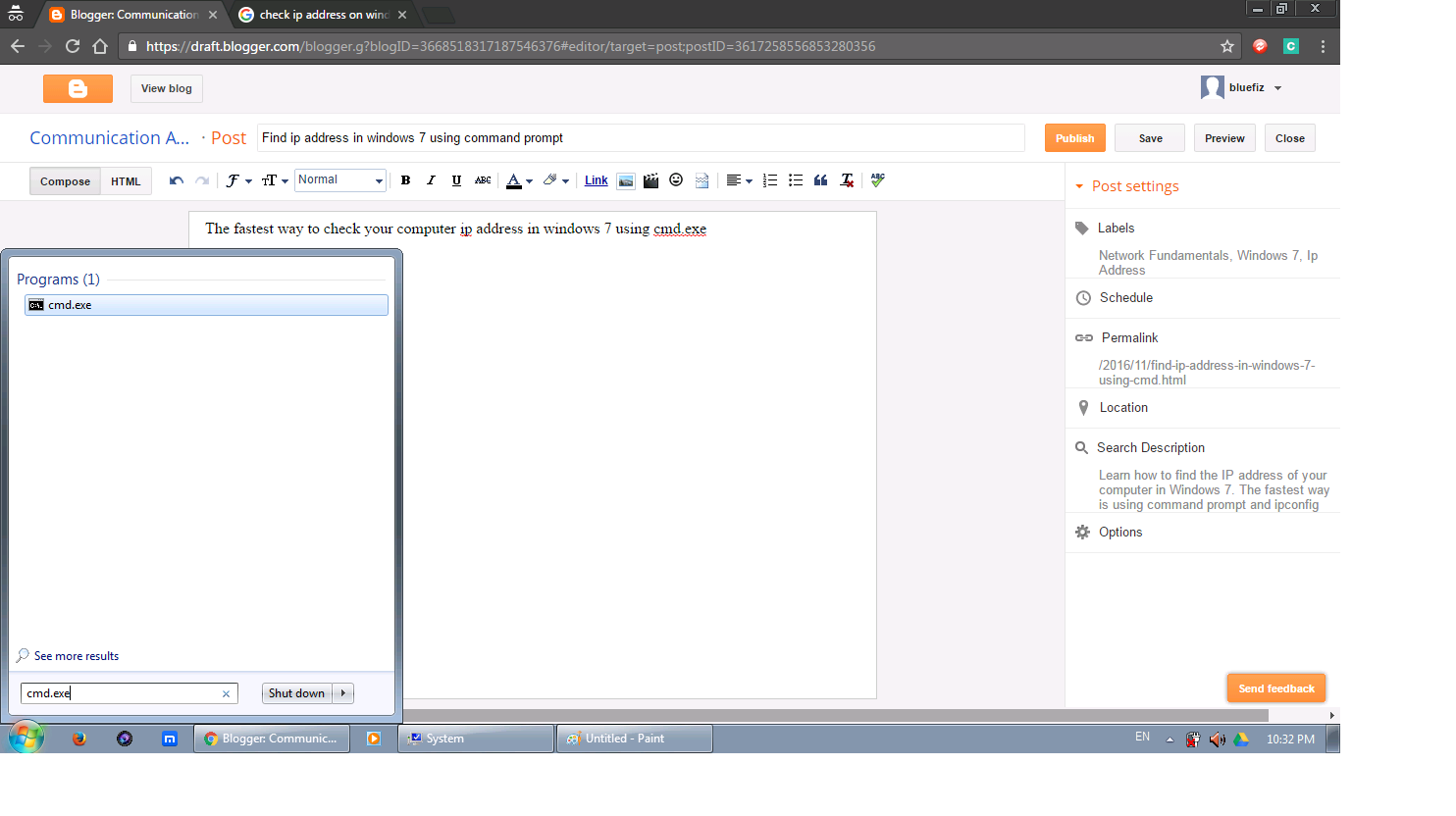
The fastest way to check your computer ip address in windows 7 using cmd.exe

At Start, search for cmd.exe. Select to run the cmd.exe

Type ipconfig in the cmd.exe. Then press enter.


You may see some result shown in the command prompt. Search for wireless if you are currently connected to wireless network, else look for local area network Ethernet adapter

Congratulations. The IPv4 as shown is the computer local area network ip address. And this is the easiest and fastest way to find ip address in windows 7 using command ipconfig.


Thursday, May 17, 2012

UCEN 3133 Advanced Computer Networks - Tutorial 4 - Year 2012

Tutorial 4 – QOS and RSVP

1. List and briefly describe the activities that a router or switch is likely to engage in to provide a certain QOS guarantee in a network.

     (i)            Policing: verifying that incoming traffic conforms to its agreed specification
   (ii)            Admission control: checking to see if there are enough resources to meet a request for QoS
 (iii)            Classification: recognizing those packets that need particular levels of QoS 
 (iv)            Queuing and scheduling: making decisions about when packets are transmitted and which packets are dropped that are consistent with the QoS guarantees


2. What is the primary difference between IntServ and DiffServ approaches to allocating resources for QOS purposes ? Which approach scales better for a large IP network and why ?

IntServ enables end-to-end QoS guarantees for a single flow (microflow) from one sender to one or more receivers through a signalling protocol like RSVP
DiffServ a coarse-grained model groups traffic of many different flows into several small classes and provides QOS guarantees on a per-class basis

DiffServ scales better. In a large IP network, the number of microflows is very large and to keep QOS and state information about each one provides a heavy burden on the routers in the network, making it difficult to scale. Grouping flows into classes allows easier management of QOS information.

3. In what way does the deficit round robin (DRR) approach provide for a more fairer QOS allocation of transmission resources on a router as compared to the weighted round robin approach ? Briefly explain how it works.

It computes weights allocated to different flows in terms of total bytes rather than number of packets. This is fairer QOS allocation because IP packets vary in size
DRR allocates a number of bytes to each flow. When a flow is selected, DRR transmits as many packets as possible without exceeding the allotted number of bytes.
The remainder (i.e. the difference between the number of bytes that was allocated and the size of the packets actually sent) becomes a deficit which is added to the amount that will be sent in the next round


4. Explain briefly how RSVP works with reference to the PATH and RESV messages.

     (i)            PATH messages travel from a sender to one or more receivers (explicitly designed to support multicast)  and include TSpecs and classification information provided by the sender.
   (ii)            When a receiver gets a PATH message, it can send a RESV message back toward the sender. The RESV message identifies the session for which the reservation is to be made and indicates the level of QoS required by this receiver.
 (iii)            Messages are intercepted by every router along the path, so that resource allocation can take place at all the necessary hops.
 (iv)            Each router must agree to reserve the resources the request specifies. Reservation is unidirectional for a single flow direction


5. Three clients are receiving shared multicast video traffic flow across a MPLS network from a media server. The routes from these different client converge on a router that the server is directly connected to. All 3 clients make a QOS reservation requests for a delay latency of 30ms, 15 ms and 10 ms respectively to this router.

     (i)            How would RSVP handle these requests in the router ?
   (ii)            How does RSVP ensure that these reservation requests are propagated correctly across the MPLS network to this router at the transmitting end ?


i) These requests are merged into a single reservation request for the common flow, to which the router will select the smallest latency of 10ms

ii) When a path message in RSVP is sent to a client, each router at each hop inserts its own IP address as the message’s last hop. Each router can look at the last hop field to learn where the flow came from. Should it later receive a reservation request for this flow, this last hop information tells it where to send the reservation request next.


6. Explain briefly what the term soft state means within the context of RSVP. Consider an ongoing video conference involving 2 clients receiving multicast traffic  from a central server. A new client wishes to join this multicast group. Outline the series of steps that it will undergo to achieve this, and show how soft state helps in this registration process.

Soft state means that PATH and RESV messages in RSVP must be sent periodically to refresh a reservation. If they are not sent for some interval (the time-out period), then the reservation is automatically torn down

  1. The client sends an IGMP group membership report message to join this multicast group.
  2. The local router receives this message and to update the rest of the network, the router builds an OSPF link state advertisement and floods it through the network.   Once all routers are updated, multicast traffic begins to flow to the new client.
  3. Path messages for the flow can reach it as well, and soft state assures that a periodic path message from the sender will eventually reach the new client.
  4. With this path message in hand, the client can identify the flow and place its own reservations.

7.  How does label distribution in MPLS assist in the creation of a RSVP reserved flows ? Describe briefly the steps involved in this process which lead to the creation of a label switched path (LSP).

Labels are bound between flows that have RSVP reservations (through the use of a FEC) and then distributed through the MPLS network.

When an LSR wants to send a RESV message for a new RSVP flow:
     (i)            It allocates a label from its pool of free labels
   (ii)            Creates an entry in its LFIB with the incoming label set to the allocated label
 (iii)            Sends out the RESV message containing this label to the upstream LSR.
 (iv)            Upon receipt of a RESV that contains this label, an LSR populates its LFIB with this label as the outgoing label
   (v)            It then allocates a new label to use as the incoming label and inserts that in the RESV message before sending it upstream.
 (vi)            As RESV messages propagate upstream, an LSP is established along the path.


8. What is meant by Per Hop Behaviour (PHB) in the context of the DiffServ approach to QOS allocation and how is it indicated ? Briefly describe the 3 main types of PHBs

DiffServ allows each node along the path to define the service that a given class will receive and this can vary from node to node along a given path, therefore DiffServ does not provide QOS end-to-end guarantees. Each of the standard PHBs is indicated by a recommended DSCP value, and each router has a table that maps the DSCP found in a packet to the PHB that will determine how that packet is treated

Default - No special treatment, equivalent to best effort.
Expedited forwarding (EF) - Packets marked EF should be forwarded with minimal delay and experience low loss.
Assured forwarding (AF) - Packets go into different priority queues where they have different drop preferences if congestion occurs

9. Briefly describe the standard approach towards congestion avoidance in TCP and state two disadvantages with this approach.   Explain how Explicit Congestion Notification (ECN) overcomes these disadvantages.

Congestion avoidance in TCP assumes that packet losses in the network are an indication of congestion, and reduce their sending rates when they experience packet loss.
Disadvantages:
     (i)            For real time applications, the lost packet will need to be transmitted and its late arrival will cause degradation
   (ii)            A lost packet consumes resources up to the point it is lost, it would be preferable not to send the packet at all if it is just going to be thrown away

Router sets “congestion experienced” (CE) bit in packet header when it detects congestion, and then forward the packets rather than dropping it. The router must have some form of queue management to actively monitor congestion. When a packet with the CE bit arrives at its destination, the receiver must send a signal back to the sender that will cause the sender to reduce its sending rate.


10. A multimedia network that provides QOS guarantees uses a leaky bucket policer in one of its routers to ensure that the incoming packet traffic does not exceed the TSpec specification agreed upon during an initial session of Integrated Services (IntServ). The following are the features of this policer:

·         The token buffer can hold at most three (3) tokens, and is initially filled with two (2) tokens at time slot t = 0.

·         New tokens arrive into the bucket at a rate of two (2) tokens per time slot. Packets arrive at the beginning of a time slot and enter the packet queue, where they are processed and transferred to the output link in a First In First Out (FIFO) manner.

·         The size of the packet queue is four  (i.e. it can queue a maximum of 4 packets at any given time slot); any extra arriving packets are dropped.

·         Packets that obtain available tokens in a given time slot go together on the same time slot in the output link.             


Time slot
Incoming Packets
0
A B C D
1
E F
2
G
3
-
4
-
5
H I J K
6
L M N O
7
P Q
8
-
9
R S T


The table shows incoming packets from the network into the router with the policer, from time slot t = 0 to time slot t = 9. Based on this information, construct a new table with columns showing the packets in queue, tokens in bucket and packets on output link from time slot t = 0 to t = 9.                                            


Time slot
Packets in queue
Tokens in bucket
Packets at output
0
A B C D
2
A B
1
C D E F
2
C D
2
E F G
2
E F
3
G
2
G
4
-
3
-
5
H I J K
3
H I J
6
K L M N
2
K L
7
M N P Q
2
M N
8
P Q
2
P Q
9
R S T
2
R S

Sunday, May 13, 2012

UCEN 3133 Advanced Computer Networks - Tutorial 2 - Year 2012

Tutorial 2 – MPLS Overview

1. Sketch the diagram of an Edge LSR (Label Switching Router). Identify 3 components that are important with respect to label switching at the periphery of an autonomous MPLS network, and briefly explain how they function.


     (i)            The Forwarding Information Base (FIB) is a standard IP forwarding table extended with labelling information. It allows labelled packets from within the MPLS core network to routed forwards as pure IP packets
   (ii)            Label Information Base (LIB) - holds all labels assigned by this LSR and the  mappings of these labels to labels received from any neighboring LSRs, during the process of label binding exchange.
 (iii)            Label Forwarding Information Base (LFIB) is used during the actual forwarding of labelled packets and holds only labels that are in use currently


2. Explain how labels can be useful as a preliminary measure  towards the enforcement of some form of QOS guarantee in a MPLS, making reference in your answer to Forward Equivalence Class (FEC)

Forwarding Equivalence Class (FECs) is a way of grouping incoming packets in some way so that all packets identified with a particular FEC are treated in the same manner, for example being switched over the same path (LSP). This allows some form of QOS to be enforced on the LSRs of the label switched path (LSP) that the packets flow through. Labels are associated with each particular FEC, and the FEC is established once at the entry of the IP packet into an ingress LSR.

3. Give examples of 3 items that can be used in classifying a Forward Equivalence Class (FEC)

     (i)            A specific source or destination IP network address
   (ii)            A specific class of traffic (e.g. interactive voice, streaming media) data within the packet
 (iii)            The particular interface on a router which the packet arrives on

4. Explain what is meant by label disposition or imposition with respect to an edge LSR.

Label imposition is the act of appending a label, or a stack of labels, to a packet in the ingress point of the MPLS domain. Label disposition is the act of removing the last label from a packet at the egress point before it is forwarded to a neighbor that is outside the MPLS domain.

5. Consider that an egress LSR in autonomous MPLS (AS 1) is communicating with its peer in another autonomous MPLS network (AS 2) using a suitable protocol (BGP for example). The process of negotiation between these peers results in a decision that exiting IP packets with a specific subnet prefix from the egress LSR in AS1 is to be routed along a specific Label Switched Path (LSP) in AS 2. Sketch an outline of how this might be accomplished using labels. What is the advantage of this approach ?

The ingress edge LSR at AS1 negotiates with the egress LSR of AS1, to append a label to all incoming packets into AS1. This label specifies that packets with a specific subnet prefix are meant to be switched immediately onwards to AS2 once they exit  from AS1. The AS1 ingress LSR builds a label stack by pushing another label corresponding to an LSP that terminates at the IP address of the AS1 egress LSR. This packet with two labels is forwarded along a LSP in AS1. All the other LSRs in the LSP in AS1 only perform switching on the top most label in the stack. Finally, at the egress LSR of AS1 this label is popped leaving the bottom label – which is used to forward the packet on to the ingress router of AS2

Thursday, June 2, 2011

CCNA Exploration 1: Network Fundamentals – Chapter 2 Exam


01. Which statements correctly identify the role of intermediary devices in the network? (Choose three.)
  • determine pathways for data
  • initiate data communications
  • retime and retransmit data signals
  • originate the flow of data
  • manage data flows
  • final termination point for data flow
02. Select the statements that are correct concerning network protocols. (Choose three.)
  • define the structure of layer specific PDU’s
  • dictate how to accomplish layer functions
  • outline the functions necessary for communications between layers
  • limit the need for hardware compatibility
  • require layer dependent encapsulations
  • eliminate standardization among vendors
03. What are two functions of encapsulation? (Choose two.)
  • tracks delay between end devices
  • enables consistent network paths for communication
  • allows modification of the original data before transmission
  • identifies pieces of data as part of the same communication
  • ensures that data pieces can be directed to the correct receiving end device
04. What is a primary function of the trailer information added by the data link layer encapsulation?
  • supports error detection
  • ensures ordered arrival of data
  • provides delivery to correct destination
  • identifies the devices on the local network
  • assists intermediary devices with processing and path selection
05. Which two layers of the OSI model have the same functions as the TCP/IP model Network Access Layer? (Choose two.)
  • Network
  • Transport
  • Physical
  • Data Link
  • Session
06.  What is a PDU?
  • corruption of a frame during transmission
  • data reassembled at the destination
  • retransmitted packets due to lost communication
  • a layer specific encapsulation
07. Which characteristic correctly refers to end devices in a network?
  • manage data flows
  • originate data flow
  • retime and retransmit data signals
  • determine pathways for data
08.
Refer to the exhibit. “Cell A” at IP address 10.0.0.34 has established an IP session with “IP Phone 1″ at IP address 172.16.1.103. Based upon the graphic, which device type best describes the function of wireless device “Cell A?”
  • the destination device
  • an end device
  • an intermediate device
  • a media device
09.
Refer to the exhibit. Which three labels correctly identify the network types for the network segments that are shown? (Choose three.)
  • Network A — WAN
  • Network B — WAN
  • Network C — LAN
  • Network B — MAN
  • Network C — WAN
  • Network A – LAN
10. Which three statements best describe a Local Area Network (LAN)? (Choose three.)
  • A LAN is usually in a single geographical area.
  • The network is administered by a single organization.
  • The connection between segments in the LAN is usually through a leased connection.
  • The security and access control of the network are controlled by a service provider.
  • A LAN provides network services and access to applications for users within a common organization.
  • Each end of the network is generally connected to a Telecommunication Service Provider (TSP).
11.
Refer to the exhibit. Which networking term describes the data interleaving process represented in the graphic?
  • piping
  • PDU
  • streaming
  • multiplexing
  • encapsulation
12. What is the primary purpose of Layer 4 port assignment?
  • to identify devices on the local media
  • to identify the hops between source and destination
  • to identify to the intermediary devices the best path through the network
  • to identify the source and destination end devices that are communicating
  • to identify the processes or services that are communicating within the end devices
13. What device is considered an intermediary device?
  • file server
  • IP phone
  • laptop
  • printer
  • switch
14.
Refer to the exhibit. Which term correctly identifies the device type that is included in the area B?
  • source
  • end
  • transfer
  • intermediary
15.
Refer to the exhibit. What type of network is shown?
  • WAN
  • MAN
  • LAN
  • WLAN
16. Which layer encapsulates the segment into packets?
  • physical
  • data link
  • network
  • transport
17. What can be identified by examining the network layer header?
  • the destination device on the local media
  • the destination host address
  • the bits that will be transferred over the media
  • the source application or process creating the data
18.
Refer to the exhibit. Which set of devices contains only end devices?
  • A, C, D
  • B, E, G, H
  • C, D, G, H, I, J
  • D, E, F, H, I, J
  • E, F, H, I, J
19. During the encapsulation process, what occurs at the data link layer?
  • No address is added.
  • The logical address is added.
  • The physical address is added.
  • The process port number is added.
20. What is the purpose of the TCP/IP Network Access layer?
  • path determination and packet switching
  • data presentation
  • reliability, flow control, and error detection
  • network media control
  • the division of segments into packets
21. What is the proper order of the layers of the OSI model from the highest layer to the lowest layer?
  • physical, network, application, data link, presentation, session, transport
  • application, physical, session, transport, network, data link, presentation
  • application, presentation, physical, session, data link, transport, network
  • application, presentation, session, transport, network, data link, physical
  • presentation, data link, session, transport, network, physical, application