search for ccna answer

Showing posts with label Cisco. Show all posts

Monday, March 10, 2014

CCNA 4 R&S Year 2014: Connecting Networks Chapter 1 v5.0 Exam Question with Answers

Connecting Networks Chapter 1 v5.0 Exam Answers 2014

1 
What are two structured engineering principles necessary for successful implementation of a network design? (Choose two.)
modularity*
security
availability
quality of service
resiliency*

2 
What is an important first consideration when starting to design a network?
size of the network* 
access security
protocols to be used
type of applications

3 
Which layer of the Cisco Collaboration Architecture contains unified communications and conference software such as Cisco WebEx Meetings, WebEx Social, Cisco Jabber, and TelePresence?
service provider edge
enterprise WAN
applications and devices* 
services module

4 
In which layer of the hierarchical enterprise LAN design model would PoE for VoIP phones and access points be considered?
core
physical
data link
access* 
distribution

5 
Which network module is the fundamental component of a campus design?
access-distribution module* 
services module
data center
enterprise edge

6 
In a hierarchical network design, which layers may be combined into a collapsed core for smaller networks?
core, distribution, and access
distribution and access
core and access
core and distribution*

7
Refer to the exhibit. Which type of ISP connectivity to the service provider edge is being used by company A?
dual-homed
dual-multihomed
single-homed
multihomed*

8 
What is one advantage to designing networks in building block fashion for large companies?
mobility
redundancy
increased network access time
failure isolation*

9 
A network engineer wants to redesign the wireless network and make use of wireless network controllers that manage the many deployed wireless access points. In which network design module of the campus network architecture would the centralized wireless network controllers be found?
services* 
access-distribution
enterprise edge
data center

10 
Which two devices would commonly be found at the access layer of the hierarchical enterprise LAN design model? (Choose two.)
Layer 3 device
firewall
access point* 
Layer 2 switch* 
modular switch

11 
Which approach in networking allows for network changes, upgrades, or the introduction of new services in a controlled and staged fashion?
modular* 
network module
borderless
static

12
Refer to the exhibit. Which type of Cisco hierarchical LAN design model is used at school site 1?
7 layer
two-tier collapsed core* 
three-tier
3 layer

13 
Which three network architectures have been introduced by Cisco to address the emerging technology challenges created by the evolving business models? (Choose three.)
Cisco Collaboration* 
Cisco Data Center* 
Cisco Borderless* 
Cisco Enterprise Edge
Cisco Enterprise Campus
Cisco Enterprise Branch

14 
Which Cisco technology allows diverse network devices to connect securely, reliably, and seamlessly to enterprise network resources?
Cisco AnyConnect*
enterprise edge
building distribution
service provider edge

15 
The network design for a college with users at five sites is being developed. Where in the campus network architecture would servers used by all users be located?
services
enterprise edge
data center* 
access-distribution

16 
What is creating a new challenge for IT departments by changing the border of the enterprise network?
tablets* 
company-owned desktops
energy costs
access layer switching

17 
Which network architecture functions through a combination of technologies that include wired, wireless, security, and more?
Cisco Borderless* 
Cisco Enterprise Campus
Cisco Enterprise Edge
Cisco Enterprise Branch

18 
Which network architecture combines individual components to provide a comprehensive solution allowing people to cooperate and contribute to the production of something?
Cisco Enterprise Campus Architecture
Cisco Enterprise Branch Architecture
Cisco Borderless Network Architecture
Cisco Collaboration Architecture*

19 
Fill in the blank.
Reducing the complexity of network design by dividing a network into smaller
areas is an example of a ” hierarchical ” network model.​

20 
Fill in the blank. Use the abbreviation.
Under the Cisco Enterprise Edge module, the submodule that provides remote access
including authentication and IPS appliances is the ” VPN ” and remote access submodule.

21

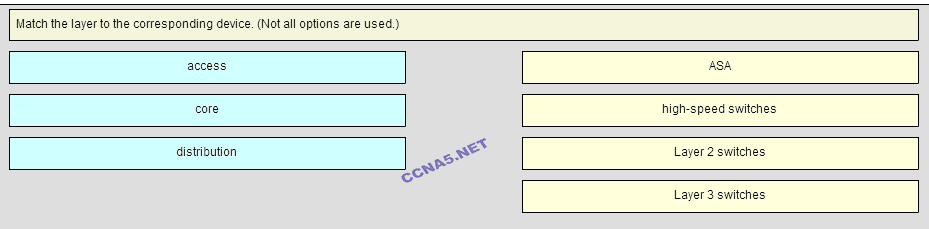
Place the options in the following order:
- not scored – 
core 
ccess 
distribution

Saturday, March 9, 2013

JAN2012 - Chapter 1 CCNA Exploration 4.0 EWAN Answer and Question


1. Which statement is true about the differences between a WAN and a LAN?
WANs generally support higher bandwidth than LANs support.
A WAN link typically traverses shorter geographic distances than a LAN link traverses.
A WAN often relies on the services of carriers, such as telephone or cable companies, but a LAN does not.
All WAN implementations generally use the same Layer 2 protocol but there are many accepted LAN Layer 2 protocols in use.
2. A U.S. company requires a WAN connection used only to transfer sales data from individual stores to the home office. All transfers will occur after business hours. The required bandwidth for this connection is estimated to be less than 38 kbps. Which type of connection requires the least investment for this company?
ATM
ISDN
analog dialup
T1 Leased Line
3. What are two advantages of an analog PSTN WAN connection? (Choose two.)
low cost
availability
traffic encryption
available bandwidth
support for voice and video
4. Which WAN technology uses a fixed payload of 48 bytes and is transported across both switched and permanent virtual circuits?
ATM
ISDN
Frame Relay
metro Ethernet
5. Which three WAN devices can be found in the cloud? (Choose three.)
ATM switches
core routers
CSU/DSU
Ethernet switches
Frame Relay switches
repeaters
6. Which term describes a device that will put data on the local loop?
DLCI
DTE
DCE
BRI
PRI
7. What is an advantage of packet-switched technology over circuit-switched technology?
Packet-switched networks are less susceptible to jitter than circuit-switched networks are.
Packet-switched networks can efficiently use multiple routes inside a service provider network.
Packet-switched networks do not require an expensive permanent connection to each endpoint.
Packet-switched networks usually experience lower latency than circuit-switched networks experience.
8. Which statement is true about data connectivity between a customer and a service provider?
Normally the CSU/DSU is the designated demarcation point for the service provider but not the customer.
The segment between the demarcation point and the central office is known as the “last mile.”
The local loop is the segment between the CSU/DSU and the serial port on a router.
Putting data on the local loop is the responsibility of the DTE.
9. A company needs a WAN connection that is capable of transferring voice, video, and data at a minimum data rate of 155 Mbps. Which WAN connection is the best choice?
X.25
DSL
ATM
ISDN BRI
ISDN PRI
10. Which statement is true of the functionality of the layers in the hierarchical network model?
The purpose of the access layer is to provide very high bandwidth communications between network devices.
Most security screening to prevent unauthorized entry to the network happens at the core layer.
Untrusted external connections are segmented from the rest of the network at all three levels.
The distribution layer aggregates WAN connections at the edge of the campus.
11. Why is the call setup time of a circuit-switched WAN implementation considered a drawback?
Routing protocols are incompatible with this function.
It restricts the communication sent to voice traffic only.
A telephone must be used to initially start transferring data.
Data cannot be transferred until a circuit has been established.
12. For digital lines, which device is used to establish the communications link between the customer equipment and the local loop?
CSU/DSU
Frame Relay switch
ISDN switch
modem
PBX switch
13. Which packet-switched WAN technology offers high-bandwidth connectivity capable of managing data, voice, and video all on the same infrastructure?
Time Division Multiplexing (TDM)
metro Ethernet
Integrated Services Digital Network (ISDN)
Public Switched Telephone Network (PSTN)
14. Which networking device is typically used to concentrate the dial-in and dial-out traffic of multiple users to and from a network?
core router
access server
Frame Relay switch
ATM switch
15. Which two devices are commonly used as data communications equipment? (Choose two.)
modem
router
CSU/DSU
ISDN switch
Ethernet switch
16. Which two features are identified with Frame Relay connections? (Choose two.)
53-byte cells
DLCI
DSLAM
PVC
SPID
17. Which statement about WAN protocols is correct?
ATM differs from other WAN protocols in that it uses variably sized packets.
Most WAN protocols use HDLC or a variant of HDLC as a framing mechanism.
The frame header consists of the frame check sequence and cyclic redundancy check.
ISDN differs from Frame Relay, HDLC, and ATM in that it is packet-switched rather than circuit-switched technology.
18. Which switching type will allow the communication devices in the provider network to be shared and only allocated to an individual subscriber during data transfer?
circuit-switched
dedicated switched lines
frame-switched
packet-switched
19. What can cause a reduction in available bandwidth on a cable broadband connection?
smaller cells
number of subscribers
committed information rate
distance from the central office of the provider
20. What three terms are associated with ISDN PRI? (Choose three.)
cell
DLCI
circuit switching
packet switching
data bearer channels
time-division multiplexing
21. At which two layers of the OSI model does a WAN operate? (Choose two.)
Physical Layer
Data Link Layer
Network Layer
Transport Layer
Presentation Layer
Application Layer
22. What type of connectivity is established when VPNs are used from the remote site to the private network?
PVCs
DLCIs
tunnels
dedicated Layer 2 links
Update : Links

Monday, March 28, 2011

CCNA netowork fundamentals Final Exam Answers 2011

1. Due to a security violation, the router passwords must be changed. What information can be learned from the following configuration entries? (Choose two.)
Router(config)# line vty 0 3
Router(config-line)# password c13c0
Router(config-line)# login

The entries specify three Telnet lines for remote access.

The entries specify four Telnet lines for remote access.

The entries set the console and Telnet password to "c13c0".

Telnet access will be denied because the Telnet configuration is incomplete.

Access will be permitted for Telnet using "c13c0" as the password.


2. Which two actions could be taken by a router if a specific match is not made to a route in the routing table? (Choose two.)

The packet will be discarded.

The packet will be sent back to the source.

The packet will be flooded out all interfaces.

Neighboring routers are polled to find the best path.


The packet will be forwarded to a default route if one is present.


3.
Refer to the exhibit. The network administrator remotely accesses the CLI of RouterB from PC1 using a secure connection. Which statement is true about this connection?

The Telnet server process is running on PC1.

Only the exchange of the Telnet username and password is encrypted.

The GET request is sent to RouterA to retrieve data.

The SSH service is used to connect PC1 to RouterB.


4.

Refer to the exhibit. What three statements are true about the IP configuration that is shown? (Choose three.)

The prefix of the subnet mask is /26.

The network on which this computer resides can have 30 hosts.

The computer is unable to communicate outside of the local network.

The address that is assigned to the computer represents private addressing.

The IP address that is assigned to the computer is routable on the Internet.

The IP address that is assigned as the default gateway is valid for this host.


5. What information can be gathered by using the command netstat?

the default gateway

the routing protocol

active TCP connections

the locally configured subnet mask


6.

Refer to the exhibit. The nslookup command that is shown was issued on a Windows PC host. What does the 10.32.5.74 address represent?

the IP address of the host

the default gateway for the host

the primary DNS server for the host

the home page address for the host


7.

Refer to the exhibit. A network administrator remotely accesses the CLI of RouterB from PC1 using Telnet. Which statement is true about this connection?

The data is automatically encrypted.

A Telnet server process is running on PC1.

The connection is made through a VTY session on the router.

A GET request was sent to RouterB to retrieve data during this session.


8. Which three addresses are private IP addresses? (Choose three.)

10.0.0.1

46.1.1.88

172.31.31.10

172.32.16.10

192.168.8.8


9.

Refer to the exhibit. Host C is able to ping 127.0.0.1 successfully, but is unable to communicate with hosts A and B in the organization. What is the likely cause of the problem?

Hosts A and B are not on the same subnet as host C.

The IP addresses on the router serial interfaces are wrong.

The subnet mask on host C is improperly configured.

The FastEthernet interface fa0/0 of router 1 is wrongly configured.


10. Which OSI layer addressing is required to route packets between two networks?

Layer 1

Layer 2

Layer 3

Layer 4


11. What is the effect of using the Router# copy running-config startup-config command on a router?

The contents of ROM will change.

The contents of RAM will change.

The contents of NVRAM will change.

The contents of flash will change.


12. A PC can not connect to any remote websites, ping its default gateway, or ping a printer that is functioning properly on the local network segment. Which action will verify that the TCP/IP stack is functioning correctly on this PC?

Use the ipconfig /all command at the host’s command prompt.

Use the ping 127.0.0.1 command at the command prompt.

Use the traceroute command at the command prompt to identify any failures on the path to the gateway.

Use FTP to check for connectivity to remote sites.

Download a troubleshooting tool from the PC manufacturer’s website.


13. Which subnet mask will allow 2040 hosts per subnet on the IP network 10.0.0.0?

255.255.0.0

255.255.254.0

255.255.252.0


255.255.248.0

255.255.240.0

255.255.255.128


14.

Refer to the exhibit. When computer A sends a frame to computer D, what computers receive the frame?

only computer D

only computer A and computer D

only computer B, computer C, and computer D

all computers


15.

Refer to the exhibit. While configuring a network, a technician wired each end of a Category 5e cable as shown. Which two statements are true about this setup? (Choose two.)


The cable is suitable for connecting a switch to a router Ethernet port.


The cable is suitable for connecting dissimilar types of devices.

The cable is unusable and must be rewired.

The cable is terminated in a way that the transmit pin is wired to the receive pin.

The cable simulates a point-to-point WAN link.


16.


Refer to the exhibit. Which layered network model is shown in the diagram?

Cisco

IETF

OSI

TCP/IP


17. An administrator makes changes to the default configuration of a router and saves them to NVRAM. After testing, it is discovered that the configurations did not have the desired effect and must be removed. What steps must be taken to remove the changes and return the router to the default configuration?

Reboot the router.

Use no version of the commands that are issued.

Issue the erase startup-config command, and then reboot the router.

Issue the erase running-config command, and then reboot the router.


18.

Refer to the exhibit. Host A and B are unable to communicate with each other. What is the reason for this?

Host A is assigned a network address.

Host B is assigned a multicast address.

Host A and host B belong to different networks.

The gateway addresses are network addresses.


19.
Refer to the exhibit. A network technician has made several changes to R1 since the configuration has last been saved. The modified configuration did not produce the desired changes. The technician wants to store a backup copy of the saved configuration on a TFTP server before reloading. Which action will cause the unmodified data to be saved on the TFTP server?


20. What can the user do from the command prompt, Router(config-line)# ?

Configure one of the network interfaces.

Configure one of the physical or virtual lines.

Verify the running configuration on the device.

Configure the parameters for one of the routing protocols.


21.

Refer to the exhibit. A PC is connected to a network. Which action will verify that the PC can communicate with its default gateway?

Use the ping 127.0.0.1 command.

Use the ipconfig command.

Use the ipconfig/all command.

Use the ping 10.0.0.254 command.


22.


Refer to the exhibit. The serial interface of the router was configured with the use of the commands that are shown. The router cannot ping the router that is directly connected to interface serial 0/0/0. What should the network technician do to solve this problem?

Configure the description at interface serial 0/0/0.

Configure an IP address on interface serial 0/0/0.

Remove the no shutdown command at interface serial 0/0/0

Reboot the router.


23. A technician is asked to secure the privileged EXEC mode of a switch by requiring a password. Which type of password would require this login and be considered the most secure?

console

enable

enable secret

VTY


24. What are two purposes for configuring a banner on a router? (Choose two.)

to announce system downtime

to prevent unauthorized access to the router

to provide a description of interface connections

to assist in legal prosecution for unauthorized access


to provide a welcome message to users who access the router


25.

Refer to the exhibit. A PC is communicating with another PC on a remote network. The two networks are connected by three routers. Which action will help to identify the path between the hosts?

Use the ipconfig command at the host.

Use the ipconfig/all command at the destination.

Use the tracert command at the host.

Use the ping command at the destination.


26.

Refer to the exhibit. Which list refers only to end devices?

D,E,F,G

A,H,B,C

A,D,E,F

A,D,E,G


27. When must a router serial interface be configured with the clock rate command?

when the interface is functioning as a DTE device

when the interface timers have been cleared

when the connected DTE device is shut down

when the interface is functioning as a DCE device


28. Which table accurately associates the RFC 1918 private IP addresses with the correct network mask?
Answer No. 1


29.


Refer to the exhibit. Which two layers of the OSI model describe the same functions as the transport and internet layers of the TCP/IP model? (Choose two.)

application layer

presentation layer

session layer

transport layer


network layer

data link layer

physical layer


30. What happens when a host station receives a frame that contains its own MAC address in the destination field?

The Layer 2 information is removed and the frame is pushed up to Layer 3.

The host station will copy the information to its buffers and send it back out.

The frame originated from the host and will be ignored.

The Layer 3 information is added to the frame.


31.

Refer to the exhibit. Host A is configured with the correct IP address for the default gateway of the router R1 FastEthernet0/1 interface. How will a packet that is sent from host A to host B be handled by the devices on the network?

R1 will drop the packet because R1 does not have a specific route in its routing table to the 10.1.1.0/24 network.


R1 will forward the packet to its default gateway, the next hop router R2. R2 will forward the packet to the directly connected network 10.1.1.0/24.

R1 will forward the packet to its default gateway, the next hop router R2. R2 will drop the packet because it does not have a default route to network 10.1.1.0/24.

R1 will forward the packet to its default gateway, the next hop router R2. R2 will drop the packet because it does not have a route that is learned by a routing protocol to network 10.1.1.0/24.


32. What type of network is maintained if a server takes no dedicated role in the network?

mainframe

client/server

peer-to-peer

centralized


33. In a network design project, a network designer needs to select a device to provide collision free connections to 40 hosts on the LAN. Which device should be selected?

hub

router

switch

firewall


34. Which TCP/IP model layer creates additional overhead on network resources due to acknowledgments, tracking, and retransmission of data?

internet

transport

application

network access


35. How many host addresses may be assigned when using the 128.107.0.0 network address with a subnet mask of 255.255.248.0?

30

256

2046

2048

4094

4096


36. Which service is used when the nslookup command is issued on a computer?

FTP

DNS

DHCP

Telnet


37. Which process provides the means to send and receive data when running multiple applications at the same time on a computer?

interleaving

sequencing

segmentation

acknowledgement


38. Which three IPv4 addresses represent valid host addresses for a subnet? (Choose three.)

10.1.12.79/28

10.1.12.113/28

10.1.12.32/28

10.1.11.5/27


10.1.11.97/27

10.1.11.128/27


39. What is the consequence of issuing the erase startup-config command in privileged EXEC mode on a Cisco router?

Data stored in RAM will be removed.

Data stored in NVRAM will be erased.

Information in flash memory will be removed.

Flags in the configuration register will be set to 0.

Both the startup-config and the running-config will be erased.


40.

Refer to the exhibit. A network technician is trying to determine the correct IP address configuration for Host A. What is a valid configuration for Host A?

IP address: 192.168.100.19; Subnet Mask: 255.255.255.248; Default Gateway: 192.16.1.2

IP address: 192.168.100.20; Subnet Mask: 255.255.255.240; Default Gateway: 192.168.100.17

IP address: 192.168.100.21; Subnet Mask: 255.255.255.248; Default Gateway: 192.168.100.18

IP address: 192.168.100.22; Subnet Mask: 255.255.255.240; Default Gateway: 10.1.1.5

IP address: 192.168.100.30; Subnet Mask: 255.255.255.240; Default Gateway: 192.168.1.1

IP address: 192.168.100.31; Subnet Mask: 255.255.255.240; Default Gateway: 192.168.100.18


41. What is the Cisco IOS?

system software for Cisco devices

Read Only Memory in Cisco devices

non-volatile storage for device configurations

an initial operating system that is used for boot functions


42. Which router configuration mode will require user authentication if an administrator issues the enable secret command?

user executive mode

privileged executive mode

global configuration mode

service specific configuration mode


43. Which command or commands will require authentication to access the privileged exec mode?

RTRA(config)# enable secret cisco
RTRA(config)# service password encryption

RTRA(config)# line con 0
RTRA(config-line)# login
RTRA(config-line)# password cisco

RTRA(config)# line vty 0 4
RTRA(config-line)# login
RTRA(config-line)# password cisco


44. A routing issue has occurred in your internetwork. Which of the following type of devices should be examined to isolate this error?

access point

host

hub

router

switch


45. Which statement is true about Layer 3 addresses?

They are physical addresses.

They are used in routing decisions.

They are only used on local networks.

They are altered each time a packet crosses a router.


46.
Refer to the exhibit. An administrator on PC1 wants to view some HTML code from a web page housed on the web server. Which client application will allow this request to be started?


47. Which OSI layer does IP rely on to determine whether packets have been lost and to request retransmission?

application

presentation

session

transport


48.

Refer to the exhibit. PC1 is unable to access PC2. To troubleshoot this problem, the technician needs to confirm that the next hop interface is operational. Which default gateway address should the technician ping from PC1 to confirm this?

10.0.0.254

192.168.0.249

192.168.0.250

10.0.1.254


49. An administrator is in the middle of entering a lengthy command when suddenly output from the IOS appears stating that an interface has gone down and then up again. Consequently, the command that the administrator was typing is no longer legible on the terminal. What CLI keystrokes can be entered to return to the line that the administrator was typing?

Ctrl-D

Ctrl-K

Ctrl-R


Ctrl-Z


50. Which option represents a point-to-point logical topology diagram?

Answer No. 4


51. Which physical component is used to access and perform the initial configuration on a new unconfigured router?

Answer No. 2

52. Which option shows how a router will route packets to a remote network?

Answer No. 4

Saturday, June 5, 2010

CCNA Cisco Routing Protocols and Concepts Final Exam Practice

CCNA Exploration 4.0 Module 4 all chapters Answers 
http://bluefiz.blogspot.com/2009/09/ccna-module-4-answers.html


1. What are two functions of a router? (Choose two.)
It connects multiple IP networks.
It controls the flow of data via the use of Layer 2 addresses.
It determines the best path to send packets.
It manages the VLAN database.
It increases the size of the broadcast domain

2. When a router boots, what is the default order to locate the Cisco IOS if there is no boot system command?ROM, TFTP server, flash
flash, TFTP server, ROM
flash, NVRAM, TFTP server
NVRAM, TFTP server, flash

3. Which router component is used to store the routing table?
Flash
NVRAM
ROM
SDRAM

4. Refer to the exhibit. How many routes are child routes?
1
3
4
6

5. Refer to the exhibit. Which statement is true concerning the routing configuration?Using dynamic routing instead of static routing would have required fewer configuration steps.
The 10.1.1.0/24 and 10.1.2.0/24 routes have adjacent boundaries and should be summarized.
Packets routed to the R2 Fast Ethernet interface require two routing table lookups.
The static route will not work correctly
6. Refer to the exhibit. The network administrator issues the command no ip classless on Router1. What forwarding action will take place on a packet that is received by Router1 and is destined for host 192.168.0.26?
The packet will be dropped.
The packet will be forwarded to the gateway of last resort.
The packet will match the 192.168.0.0 network and be forwarded out Serial 0/0.
The packet will most closely match the 192.168.0.8 subnet and be forwarded out Serial 0/1

7. Refer to the exhibit. Routers R1 and R3 use different routing protocols with default administrative distance values. All devices are properly configured and the destination network is advertised by both protocols.
Which path will be used to transmit the data packets between PC1 and PC2?
The packets will travel via R2-R1.
The packets will travel via R2-R3.
The traffic will be load-balanced between two paths — via R2-R1 and via R2-R3.
The packets will travel via R2-R3, and the other path via R2-R1 will be retained as the backup path

8. Refer to the exhibit. Router R1 is configured as shown in the exhibit. PC1 on 172.16.1.0/24 network can reach the default gateway on R1. The rest of the routers are configured with the correct IP addresses on the interfaces. Routers R2 and R3 do not have static or dynamic routing enabled. How far will PC1 be able to successfully ping?
router R1 Fa0/0 interface
router R1 S0/0/0 interface
router R2 S0/0/0 interface
router R2 Fa0/0 and S0/0/1 interfaces
router R3 Fa0/0 and S0/0/0 interfaces

9. Refer to the exhibit. All routers are properly configured to use the EIGRP routing protocol with default settings, and the network is fully converged. Which statement correctly describes the path that the traffic will use from the 10.1.1.0/24 network to the 10.1.2.0/24 network?
It will use the A-D path only.
It will use the path A-D, and the paths A-C-D and A-B-D will be retained as the backup paths.
It will use all the paths equally in a round-robin fashion.
The traffic will be load-balanced between A-B-D and A-C-D.

10. Which two statements are true regarding link-state routing protocols? (Choose two.)
They are aware of the complete network topology.
They offer rapid convergence times in large networks.
They do not include subnet masks in their routing updates.
They rely on decreasing hop counts to determine the best path.
They do not work well in networks that require special hierarchical designs.
They pass their entire routing tables to their directly connected neighbors only
11. Refer to the exhibit. R1 knows two routes, Path A and Path B, to the Ethernet network attached to R3. R1 learned Path A to network 10.2.0.0/16 from a static route and Path B to network 10.2.0.0/16 from EIGRP. Which route will R1 install in its routing table?
Both routes are installed and load balancing occurs across both paths.
The route via Path B is installed because the EIGRP route has the best metric to network 10.2.0.0/16.
The route via Path A is installed because the static route has the best metric to network 10.2.0.0/16.
The route via Path B is installed because the EIGRP route has the lowest administrative distance to network 10.2.0.0/16.
The route via Path A is installed because the static route has the lowest administrative distance to network 10.2.0.0/16.

12. What two routing protocols use a hierarchal network topology? (Choose two.)
IS-IS
EIGRP
OSPF
RIPv1
RIPv2

13. Refer to the exhibit. Based on the output from the show running-config and debug ip rip commands, what are two of the routes that are added to the routing table of R1? (Choose two.)
R 192.168.1.0/24 [120/1] via 172.16.2.1, 00:00:24, Serial0/0/1
R 192.168.100.0/24 [120/1] via 172.16.1.1, 00:00:24, Serial0/0/0
S 192.168.1.0/24 [1/0] via FastEthernet0/0
R 192.168.9.0/24 [120/1] via 172.16.2.1, 00:00:24, Serial0/0/0
R 192.168.2.0/24 [120/1] via 172.16.1.2, 00:00:24, Serial0/0/0

14. Refer to the exhibit. The network has three connected routers: R1, R2 and R3. The routes of all three routers are displayed. What can be verified from the output?
R1 and R3 are connected to each other via the S0/0/0 interface.
The IP address of the S0/0/0 interface of R1 is 10.1.1.2.
The IP address of the S0/0/1 interface of R2 is 10.3.3.2.
R2 is connected to the S0/0/1 interface of R3.

15. Refer to the exhibit. All router interfaces are configured with an IP address and are operational. If no routing protocols or static routes are configured, what information will be included in the show ip route command output for router A?
All of the 192.168.x.0 networks will be in the routing table.
Routes to networks 192.168.1.0/24, 192.168.2.0/24, and 192.168.3.0/24 will be in the routing table.
The routing table will be empty because routes and dynamic routes have not been configured.
A default route is automatically installed in the routing table to allow connectivity between the networks.

16. Refer to the exhibit. A network administrator is accessing router R1 from the console port. Once the administrator is connected to the router, which password should the administrator enter at the R1> prompt to access the privileged EXEC mode?
Cisco001
Cisco123
Cisco789
Cisco901

17. Which of the following could describe the devices labeled “?” in the graphic? (Choose three.)
DCE
CSU/DSU
LAN switch
modem
hub

18. Refer to the exhibit. Which router is advertising subnet 172.16.1.32/28?
Router1
Router2
Router3
Router4

19. Refer to the exhibit. The show cdp neighbors command was run at R1. Which two facts about the newly detected device can be determined from the output? (Choose two.)
ABCD is a router that is connected to R1.
ABCD is a non-CISCO device that is connected to R1.
The device is connected at the Serial0/0/1 interface of R1.
R1 is connected at the S0/0/1 interface of device ABCD.
ABCD does not support switching capability.

20. A static route has been configured on a router. However, the destination network no longer exists. What should an administrator do to remove the static route from the routing table?
Change the routing metric for that route.
Nothing. The static route will go away on its own.
Change the administrative distance for that route.
Remove the route using the no ip route command.

21. Refer to the exhibit. A ping between host A and host B is successful, but pings from host A to operational hosts on the Internet fail. What is the reason for this problem?
The FastEthernet interface of R1 is disabled.
One of the default routes is configured incorrectly.
A routing protocol is not configured on both routers.
The default gateway has not been configured on host A.

22. Refer to the exhibit. The network has three connected routers: R1, R2, and R3. The routes of all three routers are displayed. All routers are operational and pings are not blocked on this network.
Which ping will fail?
from R1 to 172.16.1.1
from R1 to 192.168.3.1
from R2 to 192.168.1.1
from R2 to 192.168.3.1

23. Refer to the exhibit. What action will R2 take for a packet that is destined for 192.168.2.0?
It will drop the packet.
It will forward the packet via the S0/0/0 interface.
It will forward the packet via the Fa0/0 interface.
It will forward the packet to R1

24. Refer to the exhibit. The users on the local network 172.16.1.0/24 complain that they are unable to connect to the Internet. What step should be taken to remedy the problem?
A new static route must be configured on R1 with the R3 serial interface as the next hop.
A new default route must be configured on R1 with the R3 serial interface as the next hop.
The default route on R2 should be configured with the R3 serial interface as the next hop.
The default route on R2 must be replaced with a new static route and the next hop should be the R1 FastEthernet interface

25. Refer to the exhibit. What summary address can Router2 advertise to Router1 to reach the three networks on Routers 3, 4, and 5 without advertising any public address space or overlapping the networks on Router1?
172.16.0.0/8
172.16.0.0/10
172.16.0.0/13
172.16.0.0/20
172.16.0.0/24

26. Refer to the exhibit. Host A is unable to access the Internet, and troubleshooting has revealed that this is due to an addressing problem. What is incorrectly configured in this network?
the IP address of the Fa0/0 interface of R1
the subnet mask of the S0/0/0 interface of R1
the IP address of the S0/0/0 interface of R1
the subnet mask of the S0/0/0 interface of R2

27. Refer to the exhibit. A new PC was deployed in the Sales network. It was given the host address of 192.168.10.31 with a default gateway of 192.168.10.17. The PC is not communicating with the network properly. What is the cause?
The default gateway is incorrect.
The address is in the wrong subnet.
The host address and default gateway are swapped.
192.168.10.31 is the broadcast address for this subnet

28. Refer to the exhibit. The network administrator is planning IP addressing of a new network. What part of this addressing scheme must be changed to allow communication between host A and the server?
the IP address of the server
the default gateway of host A
the IP address of host A
the default gateway of the server

29. Which network design feature requires the deployment of a classless routing protocol?
private IP addressing
advertising default routes
variable length subnet masks
summarization on major network boundaries

30. A network administrator needs to assign the very last usable IP address in the 172.24.64.0/18 network range to the router interface that serves this LAN. Which IP address should the administrator configure on the interface?
172.16.128.154/18
172.16.255.254/18
172.24.64.254/18
172.24.127.254/18

31. Refer to the exhibit. All routers are running RIPv1. The two networks 10.1.1.0/29 and 10.1.1.16/29 are unable to access each other. What can be the cause of this problem?
Because RIPv1 is a classless protocol, it does not support this access.
RIPv1 does not support discontiguous networks.
RIPv1 does not support load balancing.
RIPv1 does not support automatic summarization.

32. Refer to the exhibit. What information can be determined from the highlighted output?
R1 is originating the route 172.30.200.32/28.
Automatic summarization is disabled.
The 172.30.200.16/28 network is one hop away from R1.
A classful routing protocol is being used

33. What does RIP use to reduce convergence time in a larger network?
It uses multicast instead of broadcast to send routing updates.
It reduces the update timer to 15 seconds if there are more than 10 routes.
It uses triggered updates to announce network changes if they happen in between the periodic updates.
It uses random pings to detect if a pathway is down and therefore is preemptive on finding networks that are down

34. A network administrator has enabled RIP on routers B and C in the network diagram. Which of the following commands will prevent RIP updates from being sent to Router A?
A(config)# router rip
A(config-router)# passive-interface S0/0
B(config)# router rip
B(config-router)# network 192.168.25.48
B(config-router)# network 192.168.25.64
A(config)# router rip
A(config-router)# no network 192.168.25.32
B(config)# router rip
B(config-router)# passive-interface S0/0
A(config)# no router rip

35. Refer to the exhibit. Both routers are using the RIP protocol. Devices on the 192.168.1.1 network can ping the S0/0/0 interface on R2 but cannot ping devices on the 192.168.2.1 network.
What is a possible cause of this problem?
The routers are configured with different versions of RIP.
R2 is not forwarding the routing updates.
The R1 configuration should include the no auto-summary command.
The maximum path number has been exceeded.

36. Which two statements are correct about the split horizon with poison reverse method of routing loop prevention? (Choose two.)
It is enabled by default on all Cisco IOS implementations.
It assigns a value that represents an infinite metric to the poisoned route.
It sends back the poisoned route update to the same interface from where it was received.
It instructs routers to hold all changes that might affect routes, for a specified period of time.
It limits the number of hops a packet can traverse through the network before it is discarded

37. Refer to exhibit. Given the topology shown in the exhibit, what three commands are needed to configure EIGRP on the Paris router? (Choose three.)
Paris(config)# router eigrp 100
Paris(config)# router eigrp
Paris(config-router)# network 192.168.6.0
Paris(config-router)# network 192.168.7.0
Paris(config-router)# network 192.168.8.0
Paris(config-router)# network 192.168.9.0

38. A router has EIGRP configured as the only routing protocol. In what way might EIGRP respond if there is no feasible successor route to a destination network and the successor route fails?
It broadcasts hello packets to all routers in the network to re-establish neighbor adjacencies.
It sends queries to adjacent neighbors until a new successor route is found.
It immediately sends its entire routing table to its neighbors.
It will set the metric for the failed route to infinity.

39. Refer to the exhibit. Hosts on the BOS Fa0/0 LAN are able to ping the Fa0/1 interface on the JAX router and all interfaces on the BOS and ORL routers. Why would hosts from the 10.0.0.0/24 network not be able to ping hosts on the Fa0/0 LAN of the JAX router?
The JAX router has the wrong process ID.
The JAX router needs the network 10.0.0.0 0.0.0.255 area 0 command.
The JAX router needs the network 192.168.3.0 0.0.0.255 area 0 command.
The BOS router needs the network 192.168.3.0 0.0.0.255 area 0 command

40. Which three statements describe the operation of routing with EIGRP? (Choose three.)
As new neighbors are discovered, entries are placed in a neighbor table.
If the feasible successor has a higher advertised cost than the current successor route, then it becomes the primary route.
If hello packets are not received within the hold time, DUAL must recalculate the topology.
The reported distance is the distance to a destination as advertised by a neighbor.
EIGRP maintains full knowledge of the network topology in the topology table and exchanges full routing information with neighboring routers in every update.
EIGRP builds one routing table that contains routes for all configured routed protocols.

41. Refer to the exhibit. What happens to a packet that has 172.16.0.0/16 as the best match in the routing table that is shown?
The packet is discarded.
The packet is flooded out all interfaces.
The packet is forwarded via Serial0/0/0.
The packet is forwarded via FastEthernet0/0.

42. A network is configured with the IP, IPX, and AppleTalk protocols. Which routing protocol is recommended for this network?
RIPv1
RIPv2
EIGRP
OSPF

43. Refer to the exhibit. Which two statements are true based on the exhibited output? (Choose two.)
Automatic summarization is disabled.
The EIGRP routing protocol is being used.
There is one feasible successor in the routing table.
The serial interface S0/0/0 is administratively down.
The router is originating the route to 172.16.1.0/24 via the S0/0/0 interface

44. Refer to the exhibit. Two routers are unable to establish an adjacency. What is the possible cause for this?
The two routers are connected on a multiaccess network.
The hello and dead intervals are different on the two routers.
They have different OSPF router IDs.
They have different process IDs

45. What command would the network administrator apply to a router that is running OSPF to advertise the entire range of addresses included in 172.16.0.0/19 in area 0?
R1(config-router)# network 172.16.0.0 0.0.0.255 area 0
R1(config-router)# network 172.16.0.0 0.0.3.255 area 0
R1(config-router)# network 172.16.0.0 0.0.15.255 area 0
R1(config-router)# network 172.16.0.0 0.0.31.255 area 0

46. What should be considered when troubleshooting a problem with the establishment of neighbor relationships between OSPF routers? (Choose two.)
OSPF interval timers mismatch
administrative distance mismatch
interface network type mismatch
no loopback interface configured
gateway of last resort not redistributed

47. Which two components are used to determine the router ID in the configuration of the OSPF routing process? (Choose two.)
the IP address of the first FastEthernet interface
the highest IP address of any logical interface
the highest IP address of any physical interface
the default gateway IP address
the priority value of 1 on any physical interface

48. What is the function of the OSPF LSR packet?
It is used to confirm the receipt of LSUs.
It is used to establish and maintain adjacency with other OSPF routers.
It is used by the receiving routers to request more information about any entry in the DBD.
It is used to check the database synchronization between routers.

49. Refer to the exhibit. All interfaces are configured with the correct IP addresses and subnet masks. OSPF has been configured as the routing protocol. During troubleshooting, it is determined that hosts on network B can ping the Lo0 interface on R1 but are unable to reach hosts on network A. What is the cause of the problem?
Routers R1 and R2 have incorrect router IDs configured.
Router R1 is unable to form a neighbor relationship with router R2.
Routers R1 and R2 have been configured in different OSPF areas.
The configuration of router R1 fails to include network A in the OSPF routing process

50. Refer to the exhibit. The interface addresses and OSPF priorities are configured as shown. Because of the boot order of the routers, router A is currently the DR and router B is the BDR. If router A fails and is replaced the next day by a new router, router D, what OSPF protocol action or actions will happen?
Router D will be elected DR, and router C will become the BDR.
Router D will be elected DR, and router B will remain the BDR.
Router C will become the DR, and router B will become the BDR.
Router B will remain the BDR, and OSPF will function on the segment via the use of only the BDR